
·



October 22, 2026
What Is a Vector Database? Where AI Finds Meaning
Table of contents
What Is a Vector Database? Discover How AI Turns Meaning Into Searchable Memory
A vector database is a database system that finds information by meaning, not just exact words. It stores vector embeddings and metadata, builds an index, and returns the items nearest to a query vector. It powers semantic search, recommendations, duplicate detection and RAG, as a PostgreSQL extension or dedicated system.
Simple example: Search “end my subscription.” A vector database finds the article titled “cancel your plan,” because both phrases mean the same thing.
Key Takeaways
• A vector database finds information by meaning, using distance between embeddings.
• Vector search is the technique; the database is the full system around it.
• Chunking, indexing, and filters shape retrieval quality.
• Hybrid search and reranking fix weak matches on exact terms.
• Benchmark with recall@k on real questions before scaling.
What Is a Vector Database?
It is a database system that helps applications find information by meaning, not just by exact words. Imagine a library where books sit beside others on the same idea, whatever their titles say. A vector database organizes data the same way.
Technically, a vector is a list of numbers that an embedding model creates so similar meanings land close together. The distance between vectors is what matters. “Python coding” sits close to “learn programming,” while “gardening tips” sits far away. Vector search is the retrieval technique that finds similar vectors.
A vector database is the system that stores, indexes, queries, and manages those vectors, usually with metadata and operational features.
Because meaning becomes math, the same idea works for text, images, audio, and products. That is why recommendations and duplicate detection rely on it too.
Entity Map
The vector database connects every component.
Embedding Model → creates → Vectors → stored in → Vector Database → accelerated by → Vector Index → scored by → Similarity Metric → narrowed by → Metadata Filter → sorted by → Reranker → feeds → RAG → grounds → LLM.
How Does a Vector Database Work?
It runs a pipeline from raw data to retrieved results.
• Collect and clean data such as documents or tickets.
• Chunk documents into small passages and embed each one.
• Store and index the vectors together with metadata.
• Embed the query using the same model.
• Retrieve the Top-K nearest vectors for the application or LLM.
Embedding models rest on ideas from how Generative AI works. Top-K means returning the K closest results, commonly three to ten. Using the same model for data and queries matters, because vectors from different models cannot be compared.
Core Design Topics
Six design decisions shape most vector database systems.
• Chunking: Oversized passages blur meaning; tiny ones lose context. Start near a few hundred tokens.
• Indexing: Approximate nearest neighbor (ANN) indexes trade a little accuracy for large speed gains.
• HNSW: Beginner view: a graph helps the system hop toward nearby vectors without checking all. Professional view: tune M, efConstruction, and efSearch to balance recall, latency, and memory.
• IVF: Beginner view: vectors form clusters, and only relevant clusters are searched. Professional view: nlist and nprobe control the recall-speed trade-off; training data is needed.
• Quantization: Beginner view: vectors shrink to save memory, with small accuracy loss. Professional view: scalar, product, and binary types cut RAM; re-measure recall.
• Similarity metrics: Cosine suits most text embeddings; dot product rewards magnitude; Euclidean measures straight-line gap. Follow your embedding model’s recommendation.
• Metadata filtering: Restrict results by language, date, product, or permission, so customers never see another team’s documents.
• Hybrid search and reranking: Combine vector search with keyword (BM25) scoring, then let a reranker re-score top candidates before the LLM sees them.
• Production operations: Plan sharding, replication, access control, backups, and monitoring for latency, recall, and cost.
Who Needs What? Beginner to Architect
• Beginner: What is it? Search by meaning.
• Developer: How do I use it? Chunking, Top-K, and retrieval for RAG and recommendations.
• Engineer: How do I optimize it? Filters, hybrid search, reranking, and recall@k evaluation.
• Architect: How do I operate it? Scale, security, reliability, and cost.
Chatbot builders should study vector databases in RAG, where embeddings become the memory that grounds answers.
Comparison Table: Vector Database vs Related Approaches
Factor | SQL Database | Keyword Search | Vector Library (FAISS) | Vector Database |
Purpose | Exact facts, transactions | Match words | Similarity search | Search by meaning |
Understands meaning | No | Weak | Yes | Yes |
Storage, filters, operations | Strong | Strong | You build them | Built in |
Best for | Structured data | Exact terms and codes | Prototypes, research | Semantic search, RAG, recommendations |
Most systems use SQL for facts and vectors for meaning.
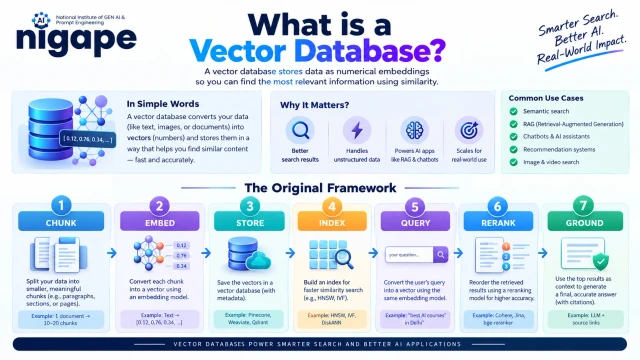
Original Framework: CHUNK → EMBED → STORE → INDEX → QUERY → RERANK → GROUND
This seven-stage model may be simplified in practice. Each stage maps to a RAG pipeline architecture, where retrieval quality decides answer quality.
User Data → Embedding Model
↓
CHUNK (passages) → EMBED (vectors)
↓
STORE (vectors + metadata) → INDEX (HNSW / IVF)
↓
QUERY (embed + filter) → RERANK (best candidates)
↓
GROUND (context to LLM) → Answer
Typical failures: oversized chunks, swapped embedding models, missing metadata, untuned indexes, vector-only search, no reranker, and unchecked hallucinations.
vect
Real-World Example
A support team has 5,000 help articles. Keyword search misses “end my subscription” when the article says “cancel your plan.”
The team chunks articles and stores embeddings with product and language metadata. A customer’s question is embedded, the top five chunks are retrieved, and the LLM answers with citations. Updates need re-indexing, not retraining. Customers now find answers even when their words differ from the article’s wording. (Illustrative.)
Skills and Tools
• Skills: Python, SQL, embeddings, RAG, evaluation.
• Dedicated databases: Qdrant, Milvus, Weaviate, Pinecone.
• Extensions and engines: pgvector, Elasticsearch, OpenSearch.
• Embedded stores and libraries: Chroma, LanceDB; FAISS, ScaNN, and Annoy are libraries, not complete databases.
• S-F-S-O check: Similarity (need meaning?), Filters (permissions, hybrid?), Scale (thousands or billions?), Operations (budget?). Low scale suggests pgvector or an embedded store; heavy filtering or strict uptime suggests a dedicated database.
Benefits and Limitations
Vector databases find meaning at scale but add complexity.
• Benefits: semantic matching, grounded RAG answers, easy updates by re-indexing, and support for text, images, and audio.
• Limitations: depends on embedding quality and chunking, can miss exact terms, does not eliminate hallucinations, and embeddings may leak sensitive data.
Common Mistakes
Most failures come from weak design. The pgvector extension adds vector similarity search to PostgreSQL without a new system, so beginners can avoid overbuilding.
• Treating FAISS as a production database.
• Ignoring chunking.
• Using only vector search when hybrid search fits better.
• Changing embedding models without re-embedding data.
• Skipping benchmarks and retrieval evaluation.
Related Entities and Topics
Embeddings, semantic search, RAG, LLMs, hybrid search, rerankers, pgvector, FAISS. The original HNSW research paper explains the graph approach behind many modern engines.
Frequently Asked Questions
1. What is a vector database in simple terms?
A database system that finds information by meaning, not exact keywords.
2. What is a vector database used for?
Semantic search, recommendations, duplicate detection, and RAG.
3. How does a vector database work?
It embeds data, indexes the vectors, and returns the Top-K nearest results.
4. Is it the same as a normal database?
No. Normal databases match exact values; vector databases find nearest meanings. Many systems combine both.
5. What is a vector database in RAG?
It stores document embeddings so the system can retrieve context for the LLM. Small projects can use pgvector instead.
6. Is PostgreSQL a vector database?
Not by default. With pgvector, it gains vector search and can serve as one.
7. Is FAISS a vector database?
No. FAISS is a similarity-search library; you must add storage, filtering, and operations yourself.
8. Which should a beginner learn first?
Start with embeddings and Top-K search, then try pgvector.
Conclusion
A vector database lets applications search by meaning. Learn embeddings, indexes, and similarity first. Then add filters, hybrid search, and reranking, and finally plan scale, security, and monitoring. Use the S-F-S-O check to choose a tool, and benchmark retrieval on your own data. Start small, measure, and scale when usage demands. Revisit your setup as data and questions change.