September 30, 2026
RAG Pipeline: From Hidden Data to Grounded AI Answers
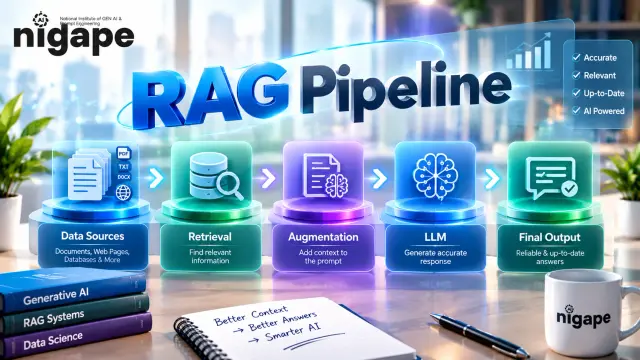
RAG Pipeline: How Hidden Data Becomes the Context Behind Grounded AI Answers
A RAG pipeline retrieves relevant information from an external knowledge source and feeds it to a language model before it generates an answer, so responses are grounded in checkable evidence. It works through ingestion, chunking, embedding, retrieval, reranking, and generation, and retrieval quality is often as important as the model itself, an idea explored further in this look at RAG in AI.
Key takeaways
● A RAG pipeline grounds AI answers in external, updatable data instead of frozen model knowledge.
● It has six core stages: ingestion, chunking, embedding, retrieval, reranking, generation.
● Retrieval quality is a common driver of poor answers, not just the language model.
● Chunking and embedding choices carry real trade-offs, with no single correct default.
● RAG reduces hallucination risk but does not eliminate it without evaluation.
● Common Mistakes
● vs. Fine-Tuning
● FAQ
What Is a RAG Pipeline?
A RAG pipeline is a system that searches an external knowledge base for relevant material and inserts it into a language model's prompt before it answers, grounding the response in retrievable evidence instead of frozen training data — a distinction that's clearer once you understand how generative AI works from prompt to output.
How It Works
User Query → Retrieval → Reranking → Context → LLM → Grounded Answer
A query is embedded and matched against a vector index, candidate chunks are reranked for relevance, and the top results become context the model reads before answering.
Why It Matters
Language models can't be updated once trained. A RAG pipeline separates knowledge from the model, so once an updated document is successfully ingested and indexed, the change reaches the next query without retraining.
Why Is a RAG Pipeline Important?
Benefit 1: Current, updatable knowledge
Documents can be added or corrected in the index, and the model can draw on that change once ingestion and indexing complete.
Benefit 2: Answers with citations
Because the answer is built from retrieved chunks, it can point to the source behind each claim — something memory alone cannot do — and framing that context well draws on prompt engineering techniques for accurate citations.
Benefit 3: Lower hallucination risk
Giving the model real evidence reduces, though doesn't eliminate, the chance it invents a plausible-sounding but incorrect answer.
RAG Pipeline Explained
Topic 1: Chunking
Chunking splits documents into retrievable passages. Chunks too small lose context; too large dilute relevance. The right size depends on the source, tested against real queries.
Topic 2: Embeddings
An embedding model converts each chunk into a vector positioned near text with similar meaning, turning retrieval into a similarity search. Good embeddings don't guarantee the closest match is correct.
Topic 3: Retrieval & Reranking
Initial retrieval pulls a broad set of candidates quickly; a reranker re-scores them precisely, so only the most relevant chunks reach the final prompt.
Topic 4: Generation & Evaluation
The LLM generates an answer from the assembled context, ideally citing sources. Evaluation checks retrieval and generation separately, since a wrong answer can come from either stage.
RAG Pipeline Architecture
Documents → Ingestion → Chunking → Embedding Model → Vector/Hybrid Index → Retriever → Reranker → Context Builder → LLM → Answer + Citations → Evaluation & Monitoring
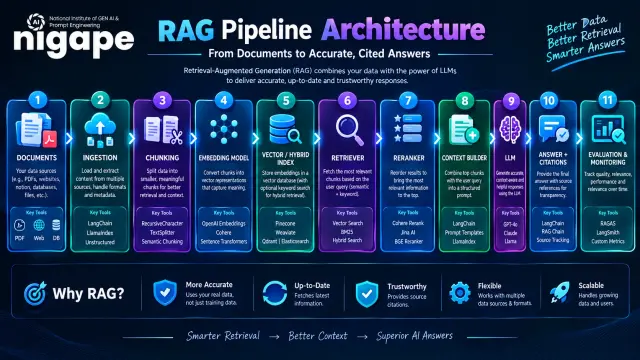
Laid out end to end, this is the full production path where each stage can make or break the answer.
5 Best Practices for a RAG Pipeline
#1 — Chunk around natural boundaries
Split on sections or paragraphs first, not arbitrary token counts, and keep overlap to preserve context.
#2 — Use hybrid search
Combine semantic and keyword retrieval so exact terms and acronyms aren't missed by embeddings.
#3 — Consider reranking when it helps
A cheap retrieval pass plus a precise reranking pass can improve relevance over retrieval alone, especially for noisy corpora, though the added latency is worth weighing.
#4 — Require citations
Instruct the model to answer only from supplied context and cite the chunk behind each claim.
#5 — Evaluate before optimizing
Build a small labeled query set with known correct sources before tuning chunk size or prompts.
Comparison Table: RAG Approaches
Approach | Best For | Trade-off |
Basic vector RAG | Small, simple datasets | Misses exact keywords |
Hybrid RAG | Mixed jargon and semantic queries | More indexing overhead |
Reranked RAG | Noisy, high-recall corpora | Added latency |
Metadata-filtered RAG | Multi-tenant or permissioned data | Requires clean metadata |
How to Build a RAG Pipeline
● Step 1 — Collect and load documents, normalizing formats.
● Step 2 — Chunk and embed the content into vectors.
● Step 3 — Index vectors in a vector store with metadata.
● Step 4 — Wire up retrieval and reranking to select top context.
● Step 5 — Generate and evaluate against a labeled query set.
Real-World Example
A support team's answers were inconsistent across agents. Their knowledge base and resolved tickets were chunked, embedded, and indexed; queries ran through hybrid retrieval and reranking. Agents then received grounded, cited answers instead of memory-based guesses.
Original Data & Expert Insight
In practice, a common cause of a bad RAG answer isn't the language model — it's a retrieval step that never found the right chunk. Fixing the model rarely fixes that; fixing retrieval usually does.
Best Tools for RAG Pipelines
Most production stacks combine a few proven layers, and it helps to check how each is documented — this breakdown of building retrieval-augmented generation is a useful start.
Layer | Common Tools |
Orchestration | LangChain, LlamaIndex, Haystack |
Vector storage | Pinecone, Qdrant, Weaviate, pgvector, FAISS |
Embeddings & LLMs | Hosted APIs or open-source via Hugging Face |
Evaluation | Labeled query sets, LLM-as-judge frameworks |
Career & Business Applications
RAG skills apply to AI, ML, NLP, and data engineering roles, and a well-evaluated pipeline cuts time spent searching internal documentation.
Common Mistakes
● Arbitrary chunk size. Fix: test against an evaluation set.
● Vector search only. Fix: add keyword retrieval alongside dense search.
● Skipping reranking. Fix: rerank before context construction.
● No source citation. Fix: require the model to cite chunks.
● Evaluating only the final answer. Fix: score retrieval and generation separately.
● No monitoring after launch. Fix: track retrieval quality on live traffic.
RAG Pipeline vs. Fine-Tuning
RAG updates what a model can reference by updating an external index — no retraining needed. Fine-tuning updates how a model behaves by adjusting its weights, which can't keep pace with fast-changing facts. RAG can support citations when the system preserves source metadata; fine-tuning alone typically cannot. Many systems combine both, an approach tracing back to the original research introducing retrieval-augmented generation.
Frequently Asked Questions
What is a RAG pipeline?
A system that retrieves external information and feeds it to a language model as context, grounding the response in real evidence.
What are the main steps in a RAG pipeline?
Ingestion, chunking, embedding, indexing, retrieval, reranking, generation, and evaluation.
Does RAG eliminate hallucinations?
No — it lowers the risk by giving the model evidence to work from, but the model can still misread that context.
What's the difference between RAG and fine-tuning?
RAG updates what a model can reference; fine-tuning updates behavior by retraining weights.
What is hybrid search in RAG?
Combining semantic vector search with keyword search so exact terms aren't missed.
How is a RAG pipeline evaluated?
By scoring retrieval accuracy and generation faithfulness separately, using labeled queries with known sources.
What is chunking in a RAG pipeline?
Splitting source documents into smaller passages so relevant sections can be retrieved.
Can RAG work with frequently changing data?
Yes — once new content is ingested and indexed, it's available without retraining the model.
Conclusion
A RAG pipeline connects a language model to current, external evidence through ingestion, chunking, embedding, retrieval, reranking, and generation. Answer quality depends heavily on retrieval quality, so chunking, hybrid search, and reranking deserve as much attention as the model itself. Evaluated stage by stage, it's one of the more direct ways to keep AI answers grounded and verifiable.
About the Author
Quick facts
Name: Shagun
From: Delhi
Education: B TECH
Program: Generative AI and Prompt Engineering
Placed in: NIGAPE (National Institute of generative ai and prompt engineering)
Covers topics: Generative AI, Prompt Engineering, Large Language Models (LLMs), AI Tools & Automation, Machine Learning, Conversational AI
Currently working as: Senior Generative AI & Prompt Engineering Trainer
In her words: "Prompt engineering and gen AI isn't about finding magic words — it's about understanding how the model thinks. That's the skill I help people build every single day."