
·



October 16, 2026
AI Tools for Content Writing: The Best AI Writing Tools 2026
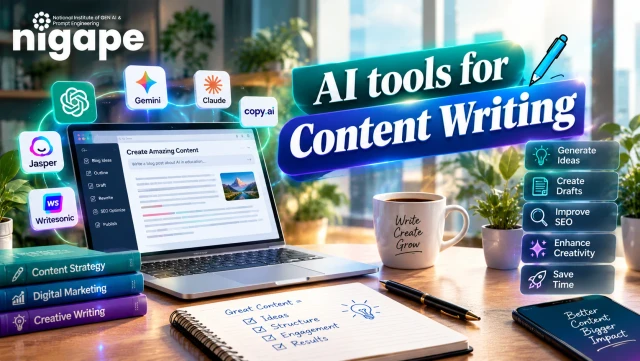
Table of contents
AI Tools for Content Writing: The Complete 2026 Guide
AI tools for content writing are software that use language models to write, edit and optimise content (blog posts, emails, ads etc). They can be used to speed up the research and initial drafting process, improve grammar and SEO and are at their most effective when a human editor checks the content for accuracy, tone and originality.
Key Takeaways
. Using an AI writing assistant can help a person in outlining thoughts, preparing rough drafts of an article, and editing. Nevertheless, an AI cannot make decisions concerning the content of the papers in the same way as people do.
. Which way of using AI writing tools is best for you will depend on what kind of writing task you deal with: whether you are writing the first draft of a paper, rewriting, or optimizing the content of the paper for SEO.
.To get quality content from AI writing tools, a human editor is needed.
.Therefore, combining several tools is more beneficial than using just one.
What Are AI Tools for Content Writing?
AI Text Generator programs acquire knowledge from a vast vocabulary database so that they can generate a range of texts by studying the patterns.
. Commonly, the text generators are capable of creating texts ranging from a short passage to full articles in only a few seconds. Besides, they are also able to create headlines, product descriptions, outlines, and captions for social media.
.Generative AI content writing applications like ChatGPT, Claude, and Gemini generate written materials in accordance with what users tell them to.
.Editing AI content writing applications, such as Grammarly or QuillBot, automate proofreading.
.SEO-focused AI applications like Surfer SEO define what topics should be covered in the text, suggest the keywords to use, and give recommendations on the structure.
Why AI Tools for Content Writing Matter in 2026
Search engines and AI answer engines started recognizing those people who create clear and organized content that is helpful.
To accomplish these tasks of providing greater quantity of content within less time without compromising quality, it is necessary for groups to create more content.
AI writing tools allow writers to save time writing drafts, searching for information and organizing their ideas in outlines.
As a result, now writers can spend more time thinking of strategies, ensuring precision and originality.
Using AI blog writing solution, a freelancer or small business can greatly reduce cost of content generation as one person can produce as much content now as previously produced by a team.
Best AI Tools for Content Writing Compared
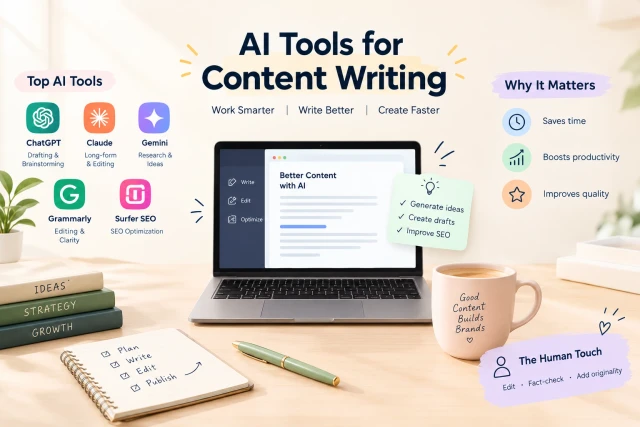
The Generative AI tools are not identical. The table below compares popular options by purpose.
Tool | Best For | Key Strength | Limitation |
ChatGPT | Drafting, brainstorming | Flexible, handles many formats | Needs fact-checking |
Claude | Long-form writing, editing | Natural tone, large context | Needs fact-checking |
Jasper | Marketing teams | Brand voice and templates | Paid plans only |
Short-form copy | Quick ad and email copy | Less suited to long articles | |
Grammarly | Editing | Grammar and clarity checks | Does not draft articles |
Surfer SEO | SEO content writing | Keyword and structure guidance | Learning curve for beginners |
Features and pricing change often, so check each tool's official website before subscribing.
AI Writing Assistant vs Human Writer
An AI can quickly and consistently create, while a writer brings a more creative, accountable, and experienced approach. Where is each more useful?
Factor | AI Writing Assistant | Human Writer |
Speed | Seconds to minutes | Hours to days |
Originality | Pattern-based, can repeat common ideas | Original ideas and experience |
Accuracy | May produce errors or outdated facts | Can verify and cite sources |
Cost | Low per article | Higher per article |
Brand voice | Needs clear instructions | Understands brand naturally |
Best use | Outlines, drafts, rewrites | Strategy, review, final edit |
The strongest workflow combines both: AI handles the draft, and a human handles judgment.
How to Use AI Tools for Content Writing Step by Step
Identify the objective of the text. Determine what subject matter is to be covered and to whom.
Search for appropriate keywords. Find one primary keyword and a group of four or five supporting keywords.
Create a rough outline. Contact your Google's guidelines for AI-generated content text generator and ask for headings. Polish the headings later.
Generate a draft. Write a section at a time, using prompts.
Edit your draft. Improve the tone of your writing, remove redundancies and add examples.
Fact-check. Establish the truth of statistics, names and statements by consulting reliable sources.
Optimize your text for SEO. Don’t forget to create a title, meta-description, headings and links.
Make sure that your text does not contain plagiarized material.
How to Choose the Right AI Tools for Content Writing
Select tools based on your preferences rather than trending tools. Here are a few things to keep in mind:
The type of content includes blog posts, online ads, e-mails, or scripts/films
Quality control: editing, proof of claim, plagiarism control functionality.
SEO tools: Free keyword ideas and content grading.
Budget: Free version or trial period.
Data privacy: Make sure the tool secures your data being processed.
Common Mistakes When Using AI Writing Tools
Publishing AI drafts without editing is a move
Trusting statistics, without verifying them can lead to claims.
Using prompts often results in generic content that lacks depth.
Ignoring search intent means your content may not reach the audience.
Creating content with no insight or experience makes it easy to blend in and get ignored.
Prompt Tips for Better Output
Improved prompts lead to improved drafts. How to Write AI Prompts That Actually Work
Be sure to add the elements below in every prompt you write:
Role: indicate what role the writer is playing, such as an SEO writer.
Audience: identify your readers and their competency level.
Format: specify headings, word count, and tone.
Keywords: formulate the main and secondary keywords.
Limitations: request no fillers, no made-up statistics, and short paragraphs.
Beginner Checklist
Select one objective for each article.
Examine a minimum of two tools with the same prompt.
Manually revise every draft.
Check all data and numbers.
Keep useful prompts on record.
Future of AI Tools for Content Writing
The advancement of AI tools for writing leads to improved assistance in education, training in brand voice and connecting with SEO systems. As always, search engines suggest meaningful, accurate and people-oriented content. Writers who possess useful information together with the AI abilities in writing blogs will achieve tremendous success.
Frequently Asked Questions
Q.Which AI tools are the best to use?
Writing has been made much simpler thanks to the presence of various AI writing tools such as ChatGPT, Jasper, Claude, Surfer SEO, and The best tool for the writer will depend on the type of writing service needed which can range from writing to editing to SEO.
Q. Can AI replace writers?
Not really. While AI can speed up the writing process, it still cannot replicate the ability of creative, strategic, and factual human writers.
Q. Can AI content be used for SEO?
Absolutely, as long as it is original, correct, and useful to readers.
Q. Are there any free writing tools?
Yes, some of them can be obtained for free in the form of trials or limited plans.
Conclusion
AI instruments contribute to faster content production but ultimately it is the human’s responsibility to ensure the quality of the content. Thus, you are advised to choose an AI writing assistant suitable for your task, create an outline and carry out the editing process before publishing.