September 22, 2026
AI Engineer Salary in India: The Salary Equation
AI Engineer Salary in India: Understand the Salary Equation Behind Experience, Skills, Company, City and AI Specialization
Here's the short version. Freshers usually land somewhere in the ₹6–18 LPA range, mid-career engineers move into ₹18–45 LPA, and by the senior level, ₹45 LPA to over ₹1 crore is on the table, using 2026 figures. But nobody actually gets paid "the average." What you earn comes from a mix of your experience, your specialization, the company you join, and the city you work in. Among all of those, Generative AI skills are what push the number up the fastest.
Key Takeaways
● There isn't a single "average" AI engineer salary in India. The figure moves a lot depending on which group of engineers gets surveyed.
● Generative AI, LLM, and RAG skills generally pay more than plain generalist ML roles.
● GCCs and product companies pay noticeably more than IT services firms for similar experience levels.
● Salaries in Bengaluru, Hyderabad, and Gurugram usually sit above the national baseline.
● Somewhere between years four and eight is when most engineers see their biggest pay jump, often tied to a move into architecture or leadership.
● Titles like "AI Engineer" and "ML Engineer" aren't standardized across companies. Check what the role actually involves before comparing pay.
What Is the AI Engineer Salary Equation?
AI engineer salary in India isn't one fixed figure. It behaves more like the result of a formula than a flat number. Two people holding the exact same job title could be earning ₹6 LPA and ₹60 LPA. Understanding why that gap exists is far more useful than memorizing an average, mainly because that understanding is what actually helps you raise your own number over time. Anyone early in their career, still deciding where to specialize, should look at the wider AI careers and salaries in India picture before committing to one path.
Core Framework
Compensation roughly breaks down like this:
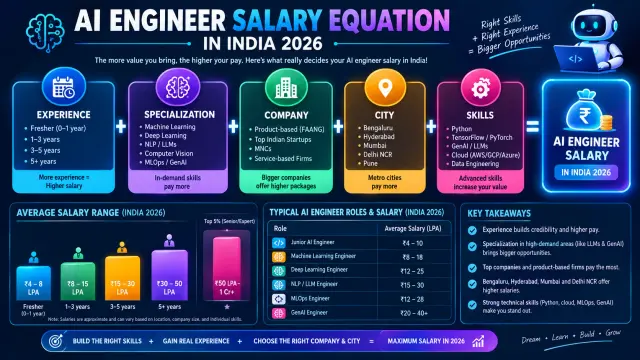
Experience + Specialization + Company Type + City + Skills = Total Compensation
None of these variables move in lockstep. A fresher with one strong Generative AI project under their belt can out-earn someone with three years of generalist ML experience. A senior engineer stuck at an IT services firm might make less than a two-year engineer at a product company. In the end, it's the whole equation that decides your pay, not the job title printed on your offer letter.
Core Components
● Experience matters, but not just the number of years. What counts more is what you actually built and shipped.
● Specialization changes your ceiling. Generalist ML, Generative AI/LLM/RAG, and MLOps each open up different pay bands.
● Company type sets the range. IT services, GCC, product company, startup, and global tech firms all pay differently for similar skill sets.
● City plays a real role too. Bengaluru and Hyderabad generally beat Pune and Chennai for comparable work.
● Skills stack on top of everything else. Python and ML basics get you in the door; GenAI, cloud, and MLOps are what get you the premium.
How It Works
Pay doesn't just add up in a straight line. It compounds. A fresher with no specialization at an IT services company typically starts around ₹6–8 LPA. Add one solid, documented GenAI project and move to a product company, and that number can climb to ₹12–18 LPA. Add several years of owning production systems plus real GenAI depth, and ₹45–55 LPA is within reach. None of this is a scientific formula. Treat it as a rough lens for understanding pay, not a guarantee of what you'll actually earn.
AI engineer salary equation showing experience, specialization, company, city and skills
Real-World Examples
● A fresher working IT services in Delhi NCR, with just Python and ML basics, typically earns ₹6–8 LPA.
● A mid-level engineer at a Bengaluru product company with a GenAI focus and RAG/LLM experience usually falls in the ₹18–35 LPA range.
● A senior engineer at a Hyderabad-based GCC, handling MLOps and architecture with real production ownership, tends to earn ₹45–60 LPA.
Entity / Topic Relationships
AI Engineer → uses → Python, Machine Learning
AI Engineer → may specialize in → Generative AI, MLOps
Generative AI Engineer → works with → LLMs, RAG
AI Compensation → varies by → Experience, City, Company Type, Specialization
Comparison Table #1: AI Engineer vs ML Engineer vs Data Scientist
Factor | AI Engineer | ML Engineer | Data Scientist |
Core focus | GenAI/LLM applications | Production ML pipelines | Analysis & predictive models |
Key skills | Python, LLM tools, APIs | Python, PyTorch/TF, MLOps | Statistics, SQL, ML basics |
Salary trend | Rising fastest | Steady growth | Slower growth |
Typical range | ₹8–45+ LPA | ₹9–52 LPA | ₹7–40 LPA |
Skills, Requirements & Tools
Python, SQL, statistics, and core ML knowledge remain the non-negotiable baseline. From there, PyTorch or TensorFlow, deep learning, NLP, and computer vision move you into mid-level pay territory. Generative AI, RAG, vector databases, and AI agents form the premium layer heading into 2026. A senior-ready profile also needs production chops: Docker, Kubernetes, cloud, MLOps, CI/CD. Structured training often closes this gap faster than self-teaching, which is part of why many engineers weigh AI courses in India before choosing where to specialize.
Comparison Table #2: Factors Affecting AI Engineer Salary
Factor | Lower-Paying Example | Higher-Paying Example |
Company type | IT services | GCC / product company |
Specialization | Generalist ML | Generative AI / LLM / RAG |
City | Tier-2/3 city | Bengaluru / Hyderabad |
Experience type | Notebook-only projects | Deployed, production systems |
Roadmap: Step-by-Step Path
Python + statistics + ML fundamentals → deep learning + APIs + cloud basics → Generative AI + RAG + LLM tools → MLOps + deployment + monitoring → one real, deployed project → apply with a target specialization in mind.
Beginner Project Example
A good starting project: build a RAG-based document assistant. Ingest documents, add retrieval, connect an LLM to answer questions, then deploy it as a simple API. Small as it sounds, it proves exactly the combination that product companies pay extra for: Python, retrieval, LLMs, and deployment.
Use Cases / Industries
Demand and pay run highest at product and SaaS companies, GCCs, fintech, e-commerce, and AI-native startups, especially where GenAI sits at the core of the product rather than as an add-on feature.
Common Mistakes
● Trusting one salary website instead of checking a few sources
● Confusing CTC with the amount that actually lands in your bank account each month
● Comparing titles alone, without checking what the role really involves
Best Practices
● Check two or three salary sources before you start negotiating.
● Ship and document one real project instead of leaving several half-finished.
● Negotiate the full package, not just base pay: CTC, bonus, and equity together.
Career / Practical Value
This equation is worth more than any single headline number. It shows you which lever, specialization, company, or city, is actually within your reach right now, something a job title can never tell you. Understanding how AI engineering skills and career scope shift as you climb levels gives you a much stronger footing for your next negotiation than any one salary figure ever could.
Public salary trackers support this. AmbitionBox listings for AI engineers in India currently show base pay from around ₹3.5 lakh up to ₹30 lakh-plus, depending on city and experience, a far wider spread than any single "average" implies. Glassdoor's India data for AI and ML roles shows the same shape: entry-level pay clustered low, senior pay climbing several times over. That's the reason this guide treats salary as a range instead of one fixed number.
FAQs
1. What is the AI engineer salary in India?
Freshers typically see ₹6–18 LPA, mid-career engineers ₹18–45 LPA, and senior engineers anywhere from ₹45 LPA to ₹1 crore-plus in 2026. Company and specialization decide where exactly you land within that.
2. What is the AI engineer salary in India for freshers?
Usually ₹6–18 LPA. IT services firms tend to start freshers near ₹6–8 LPA, while product companies pay more to freshers who show up with a documented GenAI project portfolio.
3. What is the average AI engineer salary in India?
It depends heavily on the source and the sample of engineers being measured. Treat any published average as a rough starting point, not a target to hit.
4. What is the AI engineer salary per month?
Not simply CTC divided by twelve. After tax and PF deductions, monthly take-home usually works out to 70–80% of CTC, and the exact share depends on how the salary is structured.
5. What is the AI engineer salary after 5 years?
Commonly ₹30–55 LPA, with GenAI or MLOps specialists sitting toward the top end of that range.
6. Which city pays AI engineers the most in India?
Bengaluru pays the most, with Hyderabad and Gurugram/NCR close behind, both ahead of Pune or Chennai for comparable roles.
7. Does Generative AI increase AI engineer salary?
Yes. GenAI/LLM specialists consistently report higher pay than generalist ML engineers at the same experience level.
8. What skills are needed for a high-paying AI engineering job in India?
Python and ML fundamentals form the baseline. The highest-paying roles also expect Generative AI, RAG, LLM tooling, and MLOps/deployment skills.
Conclusion
AI engineer salary in India comes down to an equation, not a single number: experience, specialization, company type, city, and skills, all working together. Freshers generally start around ₹6–18 LPA, and that can rise to ₹45 LPA or well past ₹1 crore at senior levels, with Generative AI skills adding the biggest single premium along the way. Knowing which variable you can actually shift, rather than chasing a published average, is what really moves your next offer.
About the Author
Quick facts
● Name: Shagun
● From: Delhi
● Education: B TECH
● Program: Generative AI and Prompt Engineering
● Placed in: NIGAPE (National Institute of generative ai and prompt engineering)
● Covers topics: Generative AI, Prompt Engineering, Large Language Models (LLMs), AI Tools & Automation, Machine Learning, Conversational AI
● Currently working as: Senior Generative AI & Prompt Engineering Trainer
● In her words: "Prompt engineering isn't about finding magic words — it's about understanding how the model thinks. That's the skill I help people build every single day."