October 7, 2026
Agentic AI Architecture: From Intent to Outcome
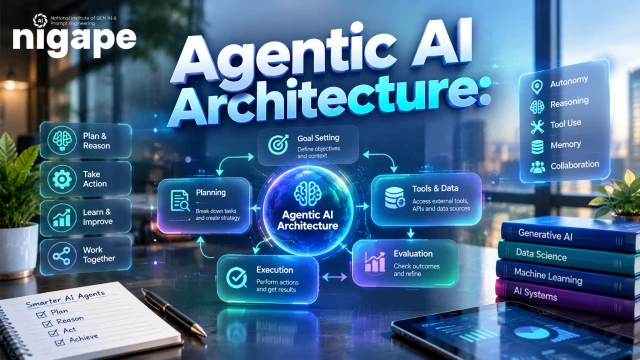
Agentic AI Architecture: The Intent-to-Outcome Blueprint Behind AI Systems That Plan, Act, Remember and Adapt
Agentic AI architecture is the system design that lets an AI agent pursue a goal through repeated cycles of planning, tool use, and feedback. A controller coordinates an LLM, memory, tools, retrieval, evaluation, and guardrails, so the system can act on external systems, observe results, and adapt rather than only generate text. Implementations vary from one agent with a few tools to multi-agent systems, but the core idea is always a controlled, goal-driven loop that keeps iterating safely until done.
Simple example: Ask an agent to "find why sales dropped." It checks the sales database, spots an anomaly, searches related records, verifies the evidence, and reports the cause.
Key Takeaways
● Agentic architecture is goal-driven: a model decides the next step and acts through tools.
● A controller wraps the LLM with planning, memory, tools, retrieval, state, evaluation, and guardrails.
● The agent loop repeats until a stop condition; one LLM call is not an agent.
● Tool calling affects the real world, so permissions and validation are central.
● Working state is essential; long-term memory and multi-agent design are optional.
● Evaluation, tracing, security, and human approval make systems dependable.
What Is Agentic AI Architecture?
It is the blueprint for software that pursues a goal by choosing steps and tools, observing results, and adjusting.
Technically, it arranges an LLM, control loop, tool interfaces, memory and state stores, retrieval, evaluation logic, and safety controls. "Architecture" defines which components exist, what each may see and do, how state flows, and what stops the system from running forever or acting unsafely. New to the topic? Start with how agentic AI works. The model is one component; reliability, cost, and safety also depend heavily on the surrounding system design, controls, and operating environment.
Entity Map
The controller sits at the center and connects every other component.
Agentic AI Architecture → contains → Agent Controller → uses → LLM, Planning, Memory, Tools, Retrieval → performs → Actions → receives → Observations → maintains → State → evaluated by → Evaluation Layer → protected by → Guardrails → monitored by → Observability.
How Does Agentic AI Architecture Work?
It runs a loop: goal, context, planning, tool selection, action, observation, state update, evaluation, then continue or stop.
The controller receives the goal and gathers instructions, memory, and retrieved knowledge.
The model proposes a step and picks a tool with structured arguments.
The runtime, not the model, executes the call under permission rules.
The result returns as an observation and updates state.
An evaluator decides: continue, replan, escalate to a human, or stop.
Multiple steps are needed because real tasks depend on information unavailable at the start. Mid-task document lookups often use a retrieval step built on RAG in AI architecture.
Core Design Topics
Six design decisions shape most agent systems.
● Agent loop: Repeats observe → plan → act → evaluate. Set stopping conditions, iteration caps, limited retries, and human pause points.
● Planning: Splits a goal into ordered subtasks and revises them when results change. Thin data triggers replanning.
● Tool calling: The model requests an operation with structured arguments. Use typed schemas, least-privilege permissions, validation, timeouts, and credentials kept outside prompts. Model Context Protocol (MCP) is a common standard for connecting agents to tools and data.
● Memory: Short-term memory is current context; working state tracks run progress; long-term memory (semantic facts, episodic events) persists across sessions. Start with working state; memory adds poisoning and privacy risk.
● RAG: Not the same as agentic AI, but often a tool inside an agent. The agent decides whether to retrieve, reformulate queries, or verify results.
● Single vs multi-agent: One agent is simpler and easier to debug. Multi-agent patterns add specialization but also coordination cost and failure propagation. Add agents only when roles are truly distinct.
Clear instructions guide every step, so learn prompt engineering for AI agents.
Comparison Table: Agentic AI vs Related Approaches
Factor | Chatbot | RAG | Workflow Automation | Agentic AI |
Purpose | Respond | Ground answers | Run fixed steps | Achieve goals |
Flow | Input → reply | Retrieve → generate | A → B → C | Plan → act → observe → adapt |
Autonomy | Low | Low | None | Variable; set by permissions and approval gates |
Predictability | High | High | Highest | Generally lower than fixed workflows |
Best for | Q&A | Document Q&A | Stable processes | Uncertain multi-step tasks |
Boundaries blur: a chatbot with search already acts agentically.
Original Framework: PERCEIVE → PLAN → ACT → OBSERVE → REMEMBER → EVALUATE → ADAPT
This seven-stage model describes the loop; real systems may simplify or merge stages.
text
User Goal → Controller
↓
PERCEIVE (context) → PLAN (steps)
↓
ACT (validated tool call) → OBSERVE (sanitized result)
↓
REMEMBER (state update) → EVALUATE (check progress)
↓
ADAPT (retry / replan / escalate) → Result
Typical failures: oversized context (perceive), over-planning (plan), unauthorized calls (act), prompt injection through tool text (observe), memory poisoning (remember), self-approval bias (evaluate), and endless retries (adapt).
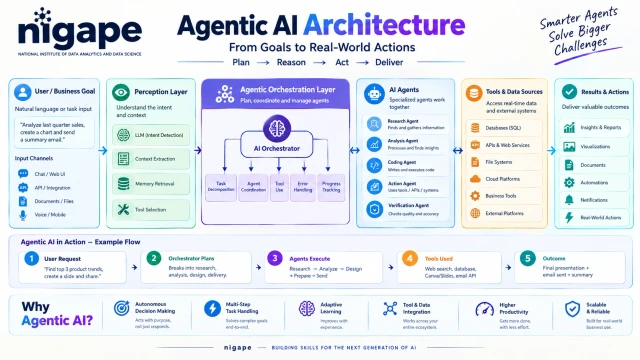
Real-World Example
Asked "find why last week's signups dropped," an agent investigates instead of guessing.
It queries the analytics database, notices a one-day gap, searches deployment logs, finds a release, and reports evidence after verifying it. (Illustrative.)
Skills and Tools
Building agents needs Python, API design, LLM patterns, retrieval, and evaluation skills.
● Skills: Python, APIs, prompt engineering, tool calling, RAG, evaluation.
● Frameworks: LangGraph, LangChain, LlamaIndex, AutoGen, CrewAI, Semantic Kernel, or Haystack. None is universally best; verify current capabilities in official docs.
● Infrastructure: vector databases, Docker, Kubernetes, cloud, tracing tools.
Benefits and Limitations
Agents handle uncertain multi-step work but trade away predictability.
● Benefits: adapts to changing conditions, uses tools, automates complex tasks.
● Limitations: variable behavior, higher cost and latency, security exposure through tools, harder testing and debugging.
Common Mistakes
Many production failures arise from missing controls around tools, state, evaluation, permissions, and iteration, not only from model capability.
● Using agents where deterministic workflows suffice.
● Excessive tool permissions.
● No tool validation or iteration limit.
● No evaluation or observability.
● Too many agents.
● No human approval for high-risk actions.
Related Entities and Topics
AI agents, multi-agent systems, agentic RAG, LLMs, vector databases, knowledge graphs, MLOps, AI governance.
Evidence and Sources
Anthropic's engineering guide, Building Effective Agents, recommends simple, composable patterns before framework complexity.
For risks such as prompt injection and excessive agency, review the OWASP Top 10 for LLM Applications.
Also consult the ReAct and original RAG papers and the NIST AI Risk Management Framework.
Frequently Asked Questions
1. What is agentic AI architecture?
It is the design of goal-driven AI systems that plan, use tools, observe results, and adapt.
2. How does agentic AI architecture work?
It runs a loop of context, planning, tool action, observation, state update, and evaluation until a stop condition.
3. What are the components of an AI agent?
Common components are a controller, LLM, planner, memory, tools, retrieval, state, evaluator, guardrails, and observability.
4. What is the difference between AI agents and chatbots?
Chatbots respond to prompts; agents pursue goals through actions and iteration.
5. What is the difference between RAG and agentic AI?
RAG retrieves knowledge to ground answers; agentic AI orchestrates action.
6. What is multi-agent architecture?
Specialized agents, such as research, data, and review agents, cooperate under a supervisor or router.
7. How do you build an AI agent?
Define the goal, choose a model, add scoped tools, implement a capped loop, add state and evaluation.
8. What are the risks of agentic AI?
Key risks include prompt injection, excessive permissions, data leakage, memory poisoning, and runaway cost.
9. What is an agent loop?
The repeated cycle of observing, planning, acting, and evaluating until a stop condition.
10. When should you use agentic AI instead of a workflow?
Use it when steps are uncertain, conditions change, or tools must be chosen dynamically. Otherwise, choose a fixed workflow.
Conclusion
Agentic AI architecture wraps a model in a controlled loop of planning, action, and feedback. The model matters, but design determines whether the system is useful, safe, and affordable. Start with a single agent, working state, and a few scoped tools. Add retrieval, memory, or extra agents only when measured needs justify the complexity. Build evaluation, observability, and human approval gates from the very beginning of every project, so a clever demo becomes a genuinely dependable, trustworthy, production-ready agentic system.
About the Author
Quick facts
Name: Shagun
From: Delhi
Education: B TECH
Program: Generative AI and Prompt Engineering
Placed in: NIGAPE (National Institute of generative ai and prompt engineering)
Covers topics: Generative AI, Prompt Engineering, Large Language Models (LLMs), AI Tools & Automation, Machine Learning, Conversational AI
Currently working as: Senior Generative AI & Prompt Engineering Trainer
In her words: "Prompt engineering and gen AI isn't about finding magic words — it's about understanding how the model thinks. That's the skill I help people build every single day."