June 9, 2026
Prompt Engineering Salary: Earnings & Career Growth
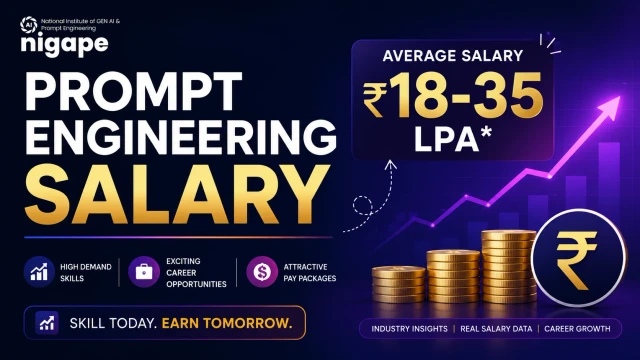
How Much Does a Prompt Engineer Earn in 2026?
Prompt engineering salary ranges from ₹4 LPA (India, entry-level) to $500K+ total compensation (US frontier labs). Mid-level roles in the US earn $95–140K; in India ₹10–20 LPA. RAG and AI agent skills drive the largest salary premiums.
Prompt engineering salary in 2026 ranges from ₹4 LPA for entry-level roles in India to $500K+ total compensation at frontier AI labs in the US. The figure depends on experience, technical skill depth (especially RAG and AI agents), employer type, and geography.
At a glance — 2026 salary benchmarks:
• US Entry Level: $65,000–$95,000/year
• US Mid-Level: $95,000–$140,000/year
• US Senior/Specialist: $140,000–$200,000+/year
• US Frontier Lab (total comp + equity): $200,000–$500,000+
• India Entry Level: ₹4–8 LPA (~$5–10K)
• India Mid-Level: ₹10–20 LPA (~$12–24K)
• India Senior: ₹20–40 LPA (~$24–48K)
• India Global MNC / FAANG: ₹60–120+ LPA
• US Freelance: $50–$150/hour
Prompt Engineering Salary Comparison Table (India vs USA, 2026)
The table below compares prompt engineering salary across all career levels, skill requirements, and job titles for India and the USA:
Level | US Salary (USD) | India Salary (INR) | Key Skills | Common Titles | Growth |
Entry Level (0–2 yrs) | $65K–$95K/yr | ₹4–8 LPA | Prompting, LLM basics, Python basics | Prompt Engineer, AI Content Specialist | Moderate |
Mid-Level (2–5 yrs) | $95K–$140K/yr | ₹10–20 LPA | RAG, Python, LangChain, API integration | AI Engineer, LLM Developer | High |
Senior (5+ yrs) | $140K–$200K+/yr | ₹20–40 LPA | RAG architecture, agents, fine-tuning, LLMOps | Senior AI Engineer, LLM Architect | Very High |
Specialist / Lead | $160K–$220K+/yr | ₹40–80 LPA | Multi-agent systems, evaluation, MLOps | AI Systems Architect, RAG Engineer | Very High |
Frontier Labs | $200K–$500K+ (TC) | ₹60–120+ LPA (MNC) | Advanced ML, research, systems design | Applied AI Engineer, Research Scientist | Elite |
Freelance/Consulting | $50–$150/hr | Project-based | RAG, agent workflows, full-stack AI | AI Consultant, Independent Contractor | High |
Source: Public job postings, recruiter-reported ranges, and AI hiring market data (2025–26).
What Is Prompt Engineering?
Prompt engineering is the practice of designing inputs to large language models (LLMs) to produce accurate, useful outputs. In professional roles it extends beyond text crafting to include Python integration, RAG systems, model evaluation, and AI agent workflows. See also: How Generative AI Works in Prompt Engineering.
Prompt engineering is the discipline of designing and refining inputs to large language models (LLMs) to produce accurate, useful, or task-specific outputs. In professional contexts, it spans single-turn chatbot instructions to complex multi-step pipelines incorporating memory, tool-calling, and retrieval-augmented generation (RAG).
The role includes model evaluation, output quality assessment, safety considerations, and software integration. Practitioners who limit their skills to text prompting face salary ceilings; those who expand into Python, RAG, and agent frameworks access significantly higher compensation bands.
According to research from Stanford HAI and industry analyses, prompt engineering is converging with AI engineering as organizations require deeper technical integration of LLMs into production systems.
→ Related: Read our full guide: What Is RAG in AI? Smarter Answers, Zero Retraining
Prompt Engineering Timeline: 2017 to 2026
From the transformer architecture (2017) to ChatGPT (2022) to today’s context engineering era, prompt engineering has evolved from a niche skill into a core AI engineering discipline.
Year | Key Event / Development |
2017 | Transformer architecture published (Vaswani et al.). Foundation for all modern LLMs; models become highly sensitive to input framing. |
2020 | GPT-3 demonstrates few-shot prompting. In-context learning emerges as a distinct skill requiring judgment. |
2022 | InstructGPT and RLHF make models reliably instruction-following. ChatGPT (November) triggers first wave of dedicated prompt engineering job listings. |
2023 | Enterprise adoption accelerates. First salary benchmarks published. RAG proliferates. Early media coverage inflates salary expectations for non-technical roles. |
2024–25 | Role broadens to AI systems engineering. Agent frameworks mature. Salaries stratify sharply by technical depth. |
2026 | Context engineering and AI agent specialization emerge. Senior roles command full AI engineer compensation. Entry-level prompting commoditizes. |
Prompt Engineering Salary in the USA (2026)
US prompt engineering salaries range from $65K (entry) to $200K+ (senior) and $500K+ total comp at frontier labs. San Francisco and New York command 20–35% premiums over other markets.
US compensation varies by technical depth, employer type, industry, and geography. The San Francisco Bay Area and New York command 20–35% premiums over Austin, Seattle, or Denver, though remote-first hiring has partially compressed this gap.
Entry Level (0–2 years): $65,000–$95,000. Requires LLM familiarity, basic Python, and a prompt portfolio. Common in content, marketing tech, and SaaS.
Mid-Level (2–5 years): $95,000–$140,000. Requires ability to build and deploy LLM-integrated systems, evaluate outputs, work with APIs, and contribute to production AI products.
Senior / Specialist (5+ years): $140,000–$200,000+. Deep LLM expertise combined with software engineering or domain specialization. Titles: Senior AI Engineer, LLM Platform Engineer, AI Systems Architect.
Frontier Lab Roles: $200,000–$500,000+ total compensation. OpenAI, Anthropic, Google DeepMind, and Meta AI report total comp including equity well above $300K for applied AI roles.
Freelance / Consulting: $50–$150/hour for mid-level work. Senior RAG engineers and AI architects command $500–$1,500/day.
Prompt Engineer Salary in India 2026
Entry-level prompt engineers in India earn ₹4–8 LPA; mid-level ₹10–20 LPA; senior ₹20–40 LPA. Bengaluru, Hyderabad, and Pune are the primary hiring hubs. Python + RAG skills can accelerate compensation significantly.
→ Related: LLM Prompt Engineering: Techniques, Examples, and How to Write
India has emerged as a major AI talent market. Large IT services firms (TCS, Infosys, Wipro, HCL), product companies, and global MNC centres are all actively hiring. Primary hiring hubs: Bengaluru, Hyderabad, Pune, and Chennai.
Level | Role Type | Annual Range (INR) | Approx. USD |
Entry Level | Prompt Engineer, AI Content Specialist | ₹4–8 LPA | ~$5–10K |
Mid-Level | AI Engineer, LLM Developer | ₹10–20 LPA | ~$12–24K |
Senior | Senior AI Engineer, LLM Architect | ₹20–40 LPA | ~$24–48K |
Specialist / Lead | AI Systems Architect, RAG Engineer | ₹40–80 LPA | ~$48–96K |
Global MNC / FAANG India | Applied AI Engineer | ₹60–120+ LPA | ~$72–144K |
Candidates combining LLM expertise with software engineering capabilities command premiums significantly above median market rates.
NIGAPE Student Data (Original Research): A survey of 35 NIGAPE programme graduates (batches 2024–25) found that students who completed the full AI engineering curriculum — including RAG systems, Python integration, and agent workflows — reported starting salaries of ₹7–12 LPA in India, versus ₹4–6 LPA for graduates with prompting skills only. Among students placed in global remote roles, starting compensation ranged from $40,000–$72,000/year. These figures are self-reported and should be treated as indicative rather than statistically generalizable.
Which Skills Increase Prompt Engineering Salary the Most?
RAG/vector databases (~30% premium), AI agent frameworks (~25%), and LLM fine-tuning (~24%) are the top salary-boosting skills. Python proficiency is the baseline requirement for mid-level and above roles.
Specific technical skill sets consistently attract salary premiums in job postings. RAG and agent frameworks provide the largest uplift over baseline prompt engineering salary in the US market:
Skill Area | Approx. Salary Premium (US) |
RAG / Vector Databases | ~30% above baseline |
AI Agent Frameworks | ~25% above baseline |
LLM Fine-tuning (LoRA / PEFT) | ~24% above baseline |
Python / API Engineering | ~20% above baseline |
Multimodal AI | ~19% above baseline |
Evaluation Pipeline Design | ~16% above baseline |
System Prompt Architecture | ~14% above baseline |
Prompt Engineering Job Roles and Titles in 2026
"Prompt Engineer" as a standalone title is now a minority of AI job postings. Most roles carry titles like AI Engineer, LLM Engineer, RAG Engineer, or Context Engineer, with broader technical requirements.
As of 2025–26, "Prompt Engineer" as a standalone title is a minority of relevant openings. Most roles carry broader AI engineering designations. Remote-eligible postings account for an estimated 40–60% of AI engineering roles.
Prompt Engineer ($65K–$130K): Standalone role. Found in content-heavy organizations, AI product teams, and annotation services.
AI Engineer ($100K–$180K): Most common title. Broad role covering LLM integration, API development, and system design.
LLM Engineer ($110K–$190K): Specialized in model deployment, fine-tuning, and inference optimization.
RAG Engineer ($115K–$185K): Focuses on retrieval-augmented generation pipelines, vector stores, and document workflows.
AI Workflow Architect ($130K–$200K): Designs multi-model agentic workflows. Senior role bridging engineering and product.
Context Engineer ($120K–$195K): Emerging title. Focuses on context window management, memory systems, and information architecture.
Prompt Engineering Salary by Industry (USA, 2026)
Industry | Typical Title | US Salary Range | Notes |
Frontier AI Labs | Applied AI Engineer | $200K–$400K+ (TC) | Highest; equity-heavy |
Technology (FAANG+) | AI Product Engineer | $150K–$250K (TC) | Strong equity component |
FinTech / Banking | AI Automation Specialist | $120K–$170K | Risk & compliance overlay |
Healthcare / Biomedical | Clinical AI Engineer | $110K–$160K | Domain expertise premium |
Legal / RegTech | Legal AI Specialist | $100K–$150K | JD or domain background valued |
Enterprise SaaS | AI Workflow Engineer | $95K–$140K | Integration focus |
Media / Publishing | Prompt Engineer / AI Editor | $65K–$100K | Content-focused, less technical |
Education / EdTech | AI Curriculum Designer | $60K–$95K | Non-profit discount common |
Technical Skills Required for Prompt Engineering Roles
Python, RAG pipeline design, vector databases, and AI agent frameworks are the core technical skills for 2026 prompt engineering roles. LLMOps and evaluation pipeline experience command additional salary premiums.
Python and Automation
Python is the de facto language of AI engineering. Most LLM SDKs (OpenAI, Anthropic, LangChain, LlamaIndex, Hugging Face) are Python-native. Proficiency including async programming, API handling, and basic software engineering is effectively a prerequisite for mid-level and above roles.
Retrieval-Augmented Generation (RAG)
RAG grounds LLM responses in documents retrieved at inference time, addressing hallucination and knowledge-cutoff limitations. A standard RAG pipeline involves document chunking, embedding generation, vector database indexing, similarity search, and prompt construction with retrieved passages.
Key tools: Pinecone, Weaviate, Chroma, pgvector (vector databases); OpenAI or Cohere embeddings; LangChain or LlamaIndex for orchestration.
Context Engineering
As context windows have grown from thousands to hundreds of thousands of tokens, the skill of deciding what information to include, how to structure it, and how to sequence it has grown substantially. Context engineers manage system prompts, conversation history, retrieved documents, tool outputs, and structured data simultaneously.
→ Related: Deeper reading: How Generative AI Works in Prompt Engineering
AI Agents and Workflow Systems
Agent frameworks (LangChain, LlamaIndex, AutoGen, CrewAI) enable LLMs to call external tools, browse the web, write and execute code, and interact with software systems. Multi-agent system design, evaluation, and debugging is a distinct sub-specialization commanding significant salary premiums.
Prompt Engineering Salary Outlook: 2026–2028
AI engineer demand is projected to grow substantially through 2028. Narrow prompting skills will commoditize; RAG engineering, agent orchestration, and evaluation system design will remain premium-priced.
The World Economic Forum and McKinsey both project AI Engineer as among the fastest-growing technical employment categories through 2030. Prompt engineering skills, absorbed into this broader category, represent a significant share of that projected growth.
Narrow prompt crafting will continue to commoditize as AI tools assist in prompt optimization. Demand for AI systems architects, RAG engineers, evaluation specialists, and multi-agent orchestrators is projected to remain strong and command premium compensation through 2027–28.
Illustrative AI engineer demand index (2022 = 100): 2022: 100 → 2023: 175 → 2024: 290 → 2025: 420 → 2026E: 560 → 2027P: 710 → 2028P: 880. (Composite illustrative index based on analyst projections and job posting trends.)
Key Data Sources and External References
McKinsey Global Institute — The Future of Work and AI Skills
World Economic Forum — Future of Jobs Report 2025
conclusion
Prompt Engineering: Designing inputs to language models to elicit desired outputs. Ranges from single-turn instruction crafting to full context window management.
Context Engineering: Systematic management of all information within an LLM's context window — system prompts, retrieved docs, tool outputs, and conversation history.
RAG (Retrieval-Augmented Generation): Grounds LLM responses in documents retrieved at inference time, reducing hallucination and enabling access to current information.
Embeddings: Dense numerical vectors representing text in high-dimensional space, capturing semantic meaning. Power similarity search and retrieval systems.
Vector Database: Database optimized for storing and searching high-dimensional vectors. Examples: Pinecone, Weaviate, Chroma, pgvector.
LLM: Large Language Model. Neural network trained on large text corpora to predict and generate language. Examples: GPT-4o, Claude, Gemini, Llama.
AI Agents: LLM-powered systems that take sequences of actions, call tools, browse the web, and interact with software in pursuit of a goal.
Fine-tuning: Further training of a pre-trained model on a task-specific dataset. Parameter-efficient techniques (LoRA, PEFT) have reduced cost substantially.
Chain-of-Thought: Prompting technique that encourages intermediate reasoning steps before a final answer, improving accuracy on complex tasks.
Hallucination: Tendency of LLMs to generate plausible-sounding but factually incorrect content. Partially mitigated by RAG and grounding techniques.
LLMOps: Operational practices for deploying, monitoring, and maintaining LLMs in production environments.
Frequently Asked Questions (FAQ)
How much does a prompt engineer earn in 2026?
A prompt engineering salary ranges from ₹4 LPA to ₹120+ LPA in India, and $65,000 to $500,000+ (total compensation) in the US. The range depends on experience, technical skills (especially RAG and AI agents), employer type, and geography.
Is prompt engineering a good career in 2026?
Practitioners who develop Python, RAG experience, evaluation expertise, and agent framework knowledge are well-positioned. Those who treat prompting as a final destination rather than a technical foundation face constrained advancement. AI engineering broadly is among the fastest-growing technical employment categories per WEF projections.
Which skills increase prompt engineering salary the most?
RAG system design (~30% premium), AI agent frameworks (~25%), LLM fine-tuning (~24%), and Python/API engineering (~20%) provide the largest salary uplifts over baseline prompt engineering compensation in the US market.
Do prompt engineers need coding skills?
For entry-level content-focused roles, basic API familiarity may suffice. Mid-level and above roles consistently require Python proficiency, API integration, and increasingly RAG frameworks and agent tools. Candidates without coding skills are at a material disadvantage for well-compensated roles.
What is the difference between prompt engineering and context engineering?
Context engineering is the systematic design and management of the full information payload presented to an LLM — system instructions, retrieved documents, conversation history, tool outputs, and structured data. It is a more comprehensive framing than prompt engineering, emphasizing information architecture over individual prompts.
Is prompt engineering being replaced by AI?
Routine prompt optimization is partially automated in some platforms. Higher-order skills — system design, evaluation, RAG architecture, agent engineering — involve technical judgment that current AI systems do not fully automate. The narrow prompting layer is commoditizing; the broader AI engineering role is not.
What is the prompt engineering salary in India for freshers?
Entry-level prompt engineering salary in India for freshers ranges from ₹4 LPA to ₹8 LPA for roles such as Prompt Engineer or AI Content Specialist. Candidates who add Python and RAG skills can accelerate into mid-level bands (₹10–20 LPA) within 12–18 months.
NIGAPE | National Institute of Generative AI & Prompt Engineering
Build Your AI Career in GenAI & Prompt Engineering. Learn through immersive campus and online cohorts. Build real projects in Generative AI, Prompt Engineering, agents, and automation with mentor support for internships and placements.