May 9, 2026
LLM Prompt Engineering: Techniques, Examples, and How to Write
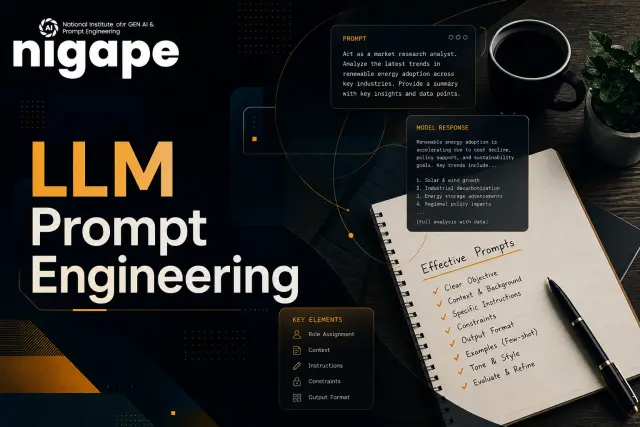
LLM Prompt Engineering: Techniques, Examples, and How to Write Effective AI Prompts
What Is LLM Prompt Engineering?
LLM prompt engineering is the process of designing structured inputs (prompts) to get accurate, relevant, and useful outputs from a large language model (LLM).
LLMs generate responses based on statistical patterns from training data. The quality, structure, and specificity of the input directly determines the quality of the output.
Related terms: AI prompting strategy, structured prompting, effective AI prompts, prompt design
What Is a Prompt in AI?
A prompt is the text input a user sends to an AI model. It can be a question, instruction, command, or a combination of all three.
Example:
"Summarize this article in 5 bullet points for a beginner audience."
The prompt controls tone, format, depth, and accuracy of the AI's response.
Why LLM Prompt Engineering Matters
Without Prompt Engineering | With LLM Prompt Engineering |
Vague, generic output | Specific, context-aware output |
Requires heavy editing | Minimal editing needed |
Single-use prompts | Reusable AI content workflow |
Mixed relevance | Goal-focused results |
Inconsistent tone | Controlled, defined tone |
No structure in response | Structured prompting output |
Bad Prompt vs. Good Prompt Examples
Example 1 — Content Writing
Bad Prompt:
Write about marketing.
Good Prompt:
You are a digital marketing expert. Write a 150-word post about Instagram ads for small businesses. Use simple English. Avoid jargon.
Example 2 — Job Application
Bad Prompt:
Write a cover letter.
Good Prompt:
You are an experienced HR professional. Write a cover letter for a junior data analyst applying to a fintech startup. Tone: professional. Length: 200 words. Highlight data skills and problem-solving.
Example 3 — Research Summary
Bad Prompt:
Tell me about climate change.
Good Prompt:
Summarize the top 5 causes of climate change in numbered points. Use data where possible. Keep each point under 30 words. Target audience: high school students.
Example 4 — Code Help
Bad Prompt:
Fix my code.
Good Prompt:
You are a Python developer. Review this function and fix the logic error causing incorrect output. Explain what was wrong in 2 sentences after the corrected code. [LLM Prompt Engineering]
Prompt Engineering Techniques
1. Role Assignment
Assign a specific identity to the AI before giving the task.
Format: "You are a [role]. [Task instruction]."
Example:
You are a financial advisor. Explain compound interest to a 25-year-old first-time investor in under 100 words.
2. Chain-of-Thought Prompting
Instruct the AI to reason step by step before producing a final answer. Reduces errors in logic-heavy tasks.
Format: "Think step by step. Then provide the final answer."
Example:
Calculate the total cost of buying 15 items at $4.75 each with 8% tax. Think step by step.
3. Few-Shot Prompting
Provide 2–3 examples of desired output before asking the AI to produce a new one.
Format: "Here are two examples: [example 1], [example 2]. Now do the same for: [new input]."
Example:
Here are two product descriptions in my style: [example A], [example B]. Write one for this product: wireless noise-cancelling headphones, $89, targeted at remote workers.
4. Output Format Instructions
Specify exactly how the response should be structured.
Format: "Respond in [format]. Each item should be [length/style]."
Example:
List 5 benefits of meditation. Use bullet points. Each bullet: one sentence, under 15 words.
5. Constraint Setting
Define what the AI should NOT do. Removes filler content and forces precision.
Format: "Do not [X]. Avoid [Y]. Keep [Z] under [limit]."
Example:
Write a product tagline. Do not use the words "innovative" or "revolutionary." Keep it under 10 words.
6. Persona + Audience Targeting
Combine the AI's assigned role with a defined target audience.
Format: "You are a [role]. Write for [specific audience]."
Example:
You are a nutrition coach. Explain protein intake to a 20-year-old beginner at the gym. Use simple words. No medical jargon.
7. Iterative Prompting
Follow up on an initial output with refinement instructions. Treat prompting as a multi-step AI content workflow.
Format: First prompt → review output → "Now [change X], [add Y], [remove Z]."
Example:
First prompt: Write an email subject line for a product launch. Follow-up: Make it more urgent. Keep it under 8 words.
8. Negative Instructions
Explicitly list what the output should exclude.
Example:
Write a blog intro. Do not start with a question. Do not use phrases like "In today's world" LLM Prompt Engineering or "Have you ever." Avoid bullet points in this section.
How to Write AI Prompts: Step-by-Step
Define the goal — State exactly what output you need (email, summary, code, list, etc.)
Assign a role — Tell the AI who it should act as before giving the task
Add context — Include audience, platform, purpose, or background information
Set format and length — Specify structure (bullets, paragraphs, table) and word/character limits
Add constraints — List what to avoid (words, tone, format, length violations)
Test and refine — Run the prompt, evaluate output, adjust one variable at a time
Prompt Engineering for Beginners: Key Terms
Term | Definition |
Prompt | Text input sent to an AI model |
LLM | Large Language Model (e.g., GPT, Claude, Gemini) |
Structured prompting | Using roles, format, and constraints in a prompt |
Few-shot prompting | Giving examples before asking for output |
Chain-of-thought | Asking AI to reason step by step |
AI content workflow | A repeatable system using AI prompts for content tasks |
Prompt template | A reusable prompt structure for repeated tasks |
Why This Blog Type Ranks in AI Search
Search AI systems (Google AI Overviews, LLM Prompt Engineering, ChatGPT browsing, Claude) extract content that is:
● Structured in question-based headings
● Written in short, extractable definition blocks
● Supported by before/after prompt examples
● Organized in numbered lists, tables, and step sections
● Skimmable without needing to read full paragraphs
This format directly answers high-intent queries such as:
● "What is prompt engineering?"
● "Prompt engineering examples"
● "How to write AI prompts"
● "Prompt engineering techniques list"
Common Prompt Engineering Mistakes
Too vague — No context, role, or format specified
No audience defined — AI defaults to generic middle-ground output
No format instructions — Output structure is inconsistent
One-shot only — Not refining after reviewing the first output
No constraints — AI includes filler, clichés, and unnecessary length
Reusing weak prompts — Not building a reusable prompt library
FAQs
What is LLM prompt engineering?
LLM prompt engineering is the process of writing structured inputs to guide AI models toward accurate, specific, and useful outputs.
Do I need coding skills for prompt engineering?
No. Prompt engineering requires clear writing and logical thinking, not programming knowledge.
Which prompt engineering techniques work best for beginners?
Role assignment, output format instructions, and constraint setting produce the fastest improvement in output quality for beginners.
What is the difference between a bad and good AI prompt?
A bad prompt is vague and unstructured. A good prompt includes a role, task, audience, format, and constraints.
Does prompt engineering work across all AI tools?
Yes. Core structured prompting principles apply to GPT, Claude, Gemini, and most major LLMs, with minor syntax differences.
Summary: LLM Prompt Engineering Checklist
● Role assigned to the AI
● Task clearly stated
● Target audience defined
● Output format specified (bullets, table, paragraph)
● Length or word limit included
● Negative instructions added
● Tested and refined iteratively
● Saved as a reusable prompt template
By NIGAPE — National Institute of Generative AI and Prompt Engineering
Build Your AI Career in GenAI & Prompt Engineering. Learn through immersive campus and online cohorts. Build real projects in Generative AI, Prompt Engineering, agents, and automation with mentor support for internships and placements.