September 16, 2026
Generative AI Skills for Beginners: Learn What Matters First
Generative AI Skills for Beginners: From Your First Prompt to AI-Powered Workflows
Generative AI skills for beginners are the practical abilities to direct AI tools and judge their output correctly: prompting, context management, and evaluation, not the math behind training models. Coding stays optional until you move from using AI to building with APIs. For a step-by-step breakdown of what actually works, see
Key Takeaways
● Prompting is a starting skill, not the finish line; evaluation decides whether output is safe to use.
● Coding is optional until you move from using AI tools to building with APIs.
● A repeatable workflow beats a clever one-off prompt.
● Each skill controls a different part of the process: instructions, memory, trust, repeatability, scale.
● Order matters more than tool count.
● Literacy comes before every other skill on this list.
What Is Generative AI Literacy?
Generative AI literacy is the ability to understand what generative models can do, where they fail, and how to verify their output. This differs from building AI, which means training or fine-tuning models and requires programming and statistics. One approach directs existing content generation; the other constructs the model itself. If you're mapping out where to begin, AI literacy skills for beginners is a useful starting point.
Core Framework
Each skill in this framework controls one distinct part of the process. Prompt engineering controls the instructions given to a model. Context management controls which information stays relevant across a session. Output evaluation controls reliability, deciding whether an answer is safe to use. Workflow design controls repeatability, turning a one-off success into a process. Automation controls scale, letting that process run without constant manual effort. For a broader look at how these pieces fit together, see Generative AI and prompt engineering.
Core Components
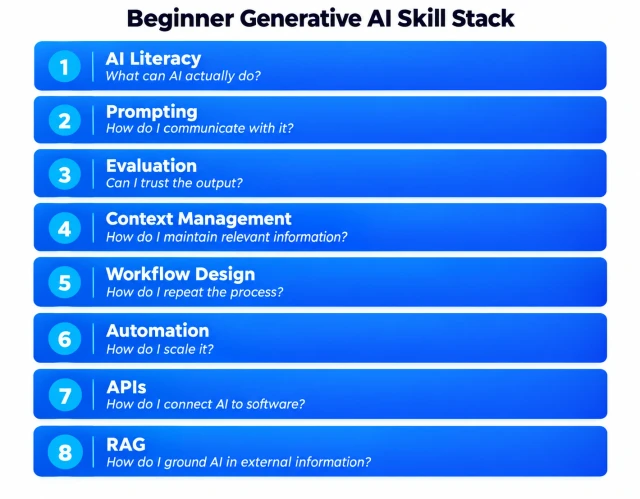
The Beginner Generative AI Skill Stack has eight levels: (1) AI literacy — what can AI actually do; (2) prompting — how do I communicate with it; (3) evaluation — can I trust the output; (4) context management — how do I maintain relevant information; (5) workflow design — how do I repeat the process; (6) automation — how do I scale it; (7) APIs — how do I connect AI to software; (8) RAG — how do I ground AI in external information.
How It Works
AI literacy means recognizing that models predict likely next words from patterns, not verified facts, so fluent output is not automatically accurate output. Prompt engineering improves the instruction given to a model by adding role, context, and format. Output evaluation checks the resulting answer against a real source before anyone acts on it.
Context management restates key constraints in long sessions so a model doesn't drift off instructions given many messages earlier. Workflow design turns that verified process into something documented and reusable: input, AI step, human check, output.
Automation then connects the workflow to tools so it runs with minimal manual effort, while APIs let software call a model directly instead of through a chat window, and RAG grounds a model's answers in your own documents instead of only its training data How to Write AI Prompts That Actually Work.
Real-World Examples
Research follows question, context, sources, prompt, AI output, verification, final answer. Marketing follows brief, AI-generated ideas, evaluate claims, edit, publish. Data analysis follows dataset, AI interpretation, verify calculations, visualization, human review. Every example follows the same underlying chain: skill, task, workflow, output, verification.
Entity and Topic Relationships
Generative AI connects to Large Language Models, which power tools like ChatGPT, Claude, and Gemini. These tools are directed through Prompt Engineering, extended through RAG, connected through APIs, scaled through Automation, and expanded through Multimodal AI toward AI Agents and AI Applications. These relationships matter more than a list of app names, because each layer depends on the one before it.
Comparison Table 1: Generative AI Skills vs. Traditional AI/ML Skills
Area | Generative AI Skills | Traditional AI/ML Skills |
Focus | Directing existing models | Building and training models |
Coding | Optional at first | Generally required |
Math | Not required to start | Statistics, linear algebra |
Projects | Writing, research, automation | Model training, evaluation pipelines |
Skills, Requirements, and Tools
Using AI for writing, research, and Q&A needs only prompting and evaluation, applied through a general assistant such as Claude, ChatGPT, or Gemini. Automating repetitive tasks needs workflow design, applied through a no-code automation platform. Building custom applications needs Python and API skills, applied through a model API directly. Answering questions from your own documents needs API and retrieval skills, applied through a RAG setup.
Comparison Table 2: Do You Need Coding to Learn Generative AI?
Stage | Coding Required |
Using AI | Not required |
Automating AI | Optional, depending on the tool |
Building AI applications | Required (Python, APIs) |
Training or fine-tuning models | Required, plus statistics and ML |
Roadmap and Step-by-Step Path
The path runs AI literacy, then prompt engineering, then output evaluation, then context management, then workflow design, then automation, then APIs with Python, then RAG or full AI applications.
● Days 1–30: build literacy and prompting habits on real tasks, not toy examples.
● Days 31–60: turn one task into a documented, repeatable workflow.
● Days 61–90: learn API basics and build one small tool.
This builds a foundation; it doesn't promise a job by day 90.
Beginner Project: Document Q&A Assistant
The strongest beginner portfolio project runs document, chunking, retrieval, model, answer, human verification. This single project touches prompting, context management, APIs, and RAG together, which is exactly the skill combination that shows growth past basic tool use.
Use Cases and Industries
Marketing, customer support, data analysis, software development, and operations all apply this same skill stack to different tasks: drafting, evaluating, and automating their own work. A support team drafts and checks responses before sending. A data team interprets output and verifies calculations before publishing a result.
Common Mistakes
Trusting output without verification, learning tools without understanding the underlying concepts, jumping to APIs before mastering prompting, and skipping project documentation are the most common mistakes. Each one traces back to skipping a stack level, not to choosing the wrong tool.
Best Practices and Responsible Use
Generative models can state false information confidently, reflect biased framing carried over from training data, and shouldn't receive confidential data without checking a tool's policy first. Keep human review inside any workflow with real consequences. NIST's AI Risk Management Framework offers a structured, vendor-neutral reference for thinking about these risks beyond a single tool or task.
Career and Practical Value
This skill stack builds judgment that survives tool changes, since the underlying process outlasts any single interface or app update. It also creates a visible, low-cost path from using AI casually to building small applications with it, which is the transition most employers now look for beyond basic tool familiarity. The World Economic Forum's Future of Jobs Report tracks this same shift toward AI-related skill demand across industries.
FAQ
Do I need to code?
No, not to start — coding matters once you're automating or building, not just using AI tools.
Is prompting enough on its own?
No — it's the foundation; real work also needs evaluation and workflow thinking.
Which tools should I learn first?
One general assistant, plus one tool each for research and writing.
How long does it take?
Basic fluency takes a few weeks; workflow and light automation skills take about 60 to 90 days.
What's the difference between AI and generative AI?
AI is the broad field of systems performing tasks that need intelligence; generative AI is the subset that creates new text, images, audio, or code.
Is AI literacy the same as prompt engineering?
No — literacy is understanding what a model can and can't do; prompting is the skill of directing it once you understand that.
Do beginners need to learn RAG?
Not immediately — it belongs later in the stack, after APIs, once you're building document-grounded applications.
What's the biggest beginner mistake?
Trusting fluent-sounding output without checking it against a real source.
Conclusion
Generative AI skills for beginners start with directing a model well: prompting, evaluating its output, and managing context, not writing code. Coding becomes relevant only once you're building rather than using. Start with one AI assistant, one real task, and a habit of checking its output; everything else in this skill stack builds from there.
About the Author
Quick facts
● Name: Shagun
● From: Delhi
● Education: B.Tech
● Program: Generative AI and Prompt Engineering
● Placed in: NIGAPE (National Institute of generative ai and prompt engineering)
● Covers topics: Generative AI, Prompt Engineering, Large Language Models (LLMs), AI Tools & Automation, Machine Learning, Conversational AI
● Currently working as: Senior Generative AI & Prompt Engineering Trainer
● In her words: "Prompt engineering isn't about finding magic words — it's about understanding how the model thinks. That's the skill I help people build every single day."