
·



October 29, 2026
DeepSeek vs ChatGPT: Choose the Right AI for the Job
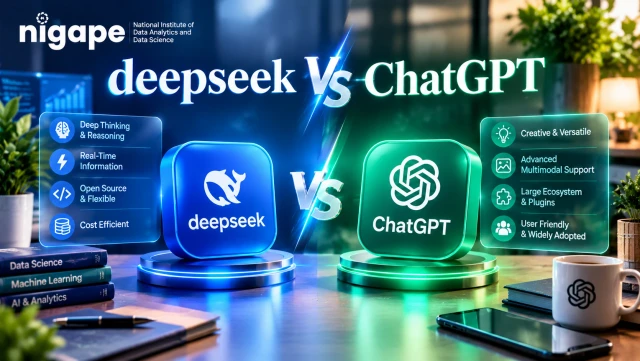
Table of contents
DeepSeek vs ChatGPT: Discover Which AI Fits Your Workflow for Reasoning, Coding, Research, Content Creation and Everyday Tasks
So, which one should you use? It depends on the job. ChatGPT, from OpenAI, is a polished app that already has search, file reading, voice and images built in. DeepSeek is leaner: a plain chat app, a low-cost API, and open-weight models that you can run on your own hardware. Neither wins across the board. Look at your task, the exact model, your plan, your budget and how private your data is. Then give both the same prompts and judge the results yourself.
Key Takeaways
● ChatGPT is a finished product. DeepSeek is mainly a model maker, and the app and API come second.
● Code is a fair test for both. Run your own, because results vary.
● A benchmark score says little about how a model handles your work.
● Prices move around. The official pages are the only safe source.
● Self-hosting is possible only with open-weight models.
Best For DeepSeek vs ChatGPT
Need | Better starting point | Why |
Beginners | ChatGPT | Easy app with built-in tools |
Low API cost | DeepSeek | Per-token pricing is low, but compare real usage |
Self-hosting | DeepSeek | Some models are open-weight |
Voice and images | ChatGPT | Wider app features |
Research | Test both | Open every cited source |
What Is DeepSeek vs ChatGPT?
Nothing fancy. It’s two AI assistants put next to each other. ChatGPT comes from OpenAI. DeepSeek comes from a Chinese AI company, which makes both the assistant and the family of models behind it. Want more options than these two? Here are some AI tools like DeepSeek and ChatGPT.
Simple Explanation
Picture the model as an engine. The assistant is the entire car around it: the seats, the steering wheel, the radio. ChatGPT is the loaded version with every extra. DeepSeek gives you a basic car, and if you like, it lets you carry the engine home too.
Technical Explanation
Under the hood, both run on a large language model (LLM). It reads text in small chunks called tokens and guesses what should come next. The context window is how much text it can keep in view at one time. A hallucination is a reply that sounds confident and turns out to be wrong. An API is the doorway that lets other software use the model. Open-weight means the model files are public. It doesn’t mean the training data or the hosted service is.
Entity Map
● DeepSeek → DeepSeek-V4.1-Flash, DeepSeek-V4-Pro → chat app, API, open-weight releases
● OpenAI → ChatGPT → GPT-5.6 and GPT-6 families → Free, Go, Plus, Pro, Business, Enterprise
These names change fast. Check the official pages before you rely on them.
How Does It Work?
You type a prompt. The tool splits it into tokens, and the model writes its answer one piece at a time. ChatGPT may add web search or read a file along the way. A raw API call usually doesn’t, so the same model can give you a different answer depending on where you use it. If you want the longer story, there’s a piece on how generative AI models produce answers.
Step-by-Step: How to Choose
Start by writing down your main task. Coding, study, research or writing?
Jot down your budget and how sensitive your data is.
For each tool, record the exact model, the plan and today’s date.
Run the same prompts in both. Wording matters, so these prompting techniques for ChatGPT and DeepSeek can help.
Score what you get back, and check it.
Pick a winner.
Important Features
● Reasoning modes to help with harder problems
● Search and citations, handy for current facts
● File upload so you can work with documents
● Voice and images, though what you get depends on the app, plan and region
● API access for developers
● Self-hosting, which only works with open-weight DeepSeek models
Search-Intent Questions
Which is better for coding? Both can do it. Try them in the language you really use.
Which is better for math? Both come with reasoning modes. Even so, check the final answer yourself.
Which is better for research? Open each source. Does it load? Does it actually back up the claim?
Which is better for writing? That’s a matter of taste. Compare them on your own draft.
Practical Example (Working Code)
Hand both tools this broken function and ask for a fix with tests:
python
def avg(xs):
return sum(xs) / len(xs) # crashes on []
A solid fix looks like this:
python
def avg(xs):
nums = [x for x in xs if type(x) in (int, float)]
if not nums:
return None
return sum(nums) / len(nums)
When no valid numbers remain, it returns None, and the caller can deal with that. One quirk: Python treats True as an int, so the type() check is what keeps booleans out. Try [] (None), [5] (5.0), [1, “a”, 3] (2.0) and [True, 2] (2.0). Notice that this version silently drops bad values. You may prefer to reject them instead.
Real-World Use Case
Here’s how it plays out in practice. A blogger drafts in ChatGPT, then asks DeepSeek to find the weak spots, and checks every fact at its source. A startup tries both APIs on 20 support questions and chooses whichever is cheaper while still scoring well.
Original Method: The 5x5 Test
Pick 5 tasks and use the same prompt in both tools. Give each answer a score from 1 to 5. A 1 means wrong or unsafe, a 3 means partly right, and a 5 means correct and clear.
Explain a hard idea to a 12-year-old.
Solve a multi-step math problem whose answer you already know.
Debug the avg code above.
Summarize a text using only the facts in it.
Ask for three real sources, then open every one.
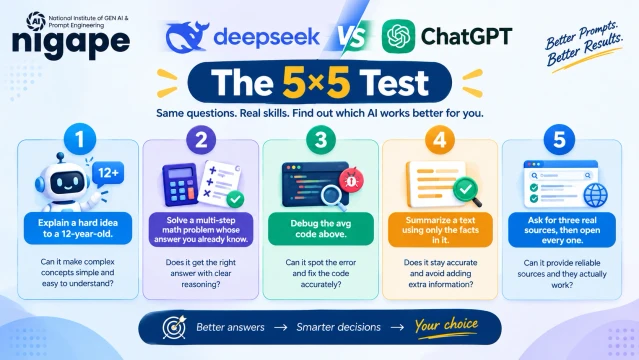
Total it out of 25. Write down the model names and the date. Do it again on another day, because answers drift. If you publish your table, keep the failures in. Present it as your own small test, not a universal benchmark.
Comparison Table
Factor | DeepSeek | ChatGPT |
Consumer app | Simple chat app, reported free | Full app with many tools |
Consumer plans | None needed for chat | Free, Go (about 20), Pro (from $100) |
API models | deepseek-flash, deepseek-v4-pro | OpenAI API models |
API billing | Per token, varies by time and caching | Per token, varies by model |
Self-host | Open-weight models only | No |
Voice and images | Check current app and model | Check current plan |
Tools and Technologies
You’ll need both apps, both APIs, Python, a score sheet, and a local runner such as Ollama.
Skills and Learning Roadmap
● Beginner: basic prompts and fact-checking
● User: writing and research with AI
● Technical: coding and debugging
● Advanced: APIs and testing
● Professional: privacy, rules and deployment
Benefits
Either tool can save you hours on drafts, code and learning. DeepSeek may cut your API bill. ChatGPT is simply the easier place to begin.
Limitations
Neither is always right. DeepSeek offers fewer consumer extras, and its model names changed in 2026. ChatGPT’s strongest models need a higher plan, and the Free and Go tiers may show ads. Self-hosting gives you more control, but it isn’t a privacy guarantee. Check licenses, logging and access controls.
Best Practices
Keep your prompts identical every time. Write down the model and the date. Verify facts. Test any code before you rely on it. And keep secrets out of your prompts.
Common Mistakes and Solutions
Mistake
Fix
Comparing different models
Note exact versions
Trusting one benchmark
Run your own 5x5 test
Comparing plan price with API price
Compare like with like
Pasting private data
Read the privacy policy first
Trusting AI citations
Open every link
Related Concepts
Prompt engineering, RAG, AI agents, multimodal AI, fine-tuning, responsible AI.
Evidence and Trusted Sources
DeepSeek lists its current API model names, limits and token pricing in its API pricing documentation.
OpenAI shows its current plans, and which models each one includes, on the ChatGPT pricing page.
FAQ
1. Is DeepSeek better than ChatGPT?
Not at everything. It comes down to your task, the model and the plan.
2. Is DeepSeek free?
Its chat app has been reported as free. The API, though, charges per token.
3. Is ChatGPT free?
Yes, with limits. Paid plans start at around $8 a month in the US.
4. Is DeepSeek safe?
Look at its data rules, not the rumors. Read the privacy policy and keep private data out. Or self-host with proper controls.
5. Is DeepSeek open source?
Some of its models are open-weight. The training data and code aren’t necessarily open.
6. Which is cheaper?
DeepSeek’s API is reported to cost less per token. Still, work out the real cost for how you’d use it.
7. Which is better for students?
Try both free tiers, and verify the answers.
8. Can I use both?
Absolutely. Draft in one, have the other critique it, then do your own check.
Conclusion
DeepSeek and ChatGPT are both useful. They just suit different people. If you want an easy app with search, files, voice and images, go with ChatGPT. If low API cost or self-hosting matters most, go with DeepSeek. Whichever you pick, check the exact model and plan, read the privacy policy, and don’t share confidential data without approval. Verify facts, and test code before you use it. Then run the 5x5 Test on your own real work and keep whichever tool scores best. Models keep changing, so keep testing.