
·


A2A Protocol Explained: How AI Agents Discover Each Other, Delegate Tasks and Exchange Results Across Different Frameworks
A2A Protocol (Agent2Agent) is an open standard that lets AI agents built by different companies, on different frameworks, work as a team. Here’s the short version. One agent publishes an Agent Card describing what it can do. Another agent reads that card, sends a message, and follows the work as a task. When the task finishes, the results come back as artifacts. Google created A2A in 2025, and the Linux Foundation now hosts it. Think of it as the teamwork layer between agents, while MCP is how a single agent reaches its own tools and data.
Key Takeaways
● A2A stands for Agent2Agent, an open protocol that lets AI agents talk to each other.
● Agent Cards are JSON files where an agent introduces itself, usually found at /.well-known/agent-card.json.
● Tasks track the work, Messages carry the conversation, and Artifacts hold the results.
● A2A vs MCP: A2A connects agents to agents. MCP connects agents to tools. In practice, they work side by side.
● Transports: JSON-RPC, HTTP+JSON/REST and gRPC.
What Is A2A Protocol?
A2A stands for Agent2Agent. It’s basically a rulebook that AI agents follow when they need to talk to one another.
An AI agentic is a program that uses a language model to plan steps and then act on them. The catch is that agents get built with all sorts of different tools, so getting them to cooperate is awkward. A2A hands them a common language.
A simple way to picture it: planes from dozens of countries land at the same airport because every pilot follows the same radio rules. A2A is that radio standard, but for agents.
Chatbot vs A2A: with a chatbot, a person talks to one AI. With A2A, one agent talks to another agent, and no human has to sit in the middle.
Why Do We Need A2A Protocol?
Without a standard, every agent-to-agent connection means writing custom code. That creates four headaches:
● Different frameworks: each one has its own way of calling agents.
● Hidden skills: one agent has no way to see what another can actually do.
● Too many custom links: every new pair of agents needs fresh glue code.
● Enterprise demands: companies want agents from several vendors working inside one workflow.
Inside any agentic AI architecture, A2A solves this by giving agents one common way to describe themselves, send work and track results. That’s all it does. It helps agents cooperate, nothing more.
How Does A2A Protocol Work?
The quick answer: a client agent reads a remote agent’s Agent Card, sends it a message, and follows the resulting task until it’s done.
The technical view: the spec is built in three layers: a data model, abstract operations, and protocol bindings (the real transports). The source of truth is a Protocol Buffers file called a2a.proto.
Client Agent Remote Agent
| 1. Get Agent Card |
|----------------------->|
| 2. Card (skills, URL) |
|<-----------------------|
| 3. SendMessage |
|----------------------->|
| 4. Task: working |
|<-----------------------|
| 5. Task: completed |
| + Artifact |
|<-----------------------|
A2A Step-by-Step Process
The client agent hits a job it can’t handle alone.
It looks for a remote agent, either from a known URL or through a registry.
It reads that agent’s Agent Card to check skills, endpoints and security needs.
It sends a message.
The remote agent gets to work. Bigger jobs turn into a Task.
Status updates, messages or artifacts come back, and updates can stream in live.
The task ends as completed, failed, canceled or rejected.
Not every request needs all that. For something simple, the remote agent might just answer with one message and skip the task entirely.
Core Parts of A2A (Simple + Technical)
Part | Simple meaning | Technical detail |
Agent Card | A business card | JSON with name, skills, supportedInterfaces, securitySchemes |
Task | A job ticket | Has an ID, context ID, status, artifacts and history |
Message | One note in a chat | Has a role (user or agent) and Parts |
Part | An item in an envelope | Text, file or data |
Artifact | The finished deliverable | Output made of Parts |
Task states: submitted, working, input-required, completed, failed, canceled, rejected. Four of those are final: completed, failed, canceled and rejected. Once a task reaches one of them, it can’t be restarted.
Practical Example (Illustrative)
Say a reporting agent asks a research agent: “Find three studies on solar adoption.”
The research agent creates a task, and its status is working.
It needs more detail, so it asks, “Which region?” The task flips to input-required.
The reporting agent replies with a new message.
The task moves to completed and returns an artifact holding the summaries.
Agent Card sample (illustrative, not official):
json
{
"name": "Research Agent",
"description": "Summarizes public sources.",
"version": "1.0.0",
"supportedInterfaces": [{ "url": "https://research.example.com/a2a" }],
"skills": [{ "id": "topic-summary", "name": "Topic summary" }]
}
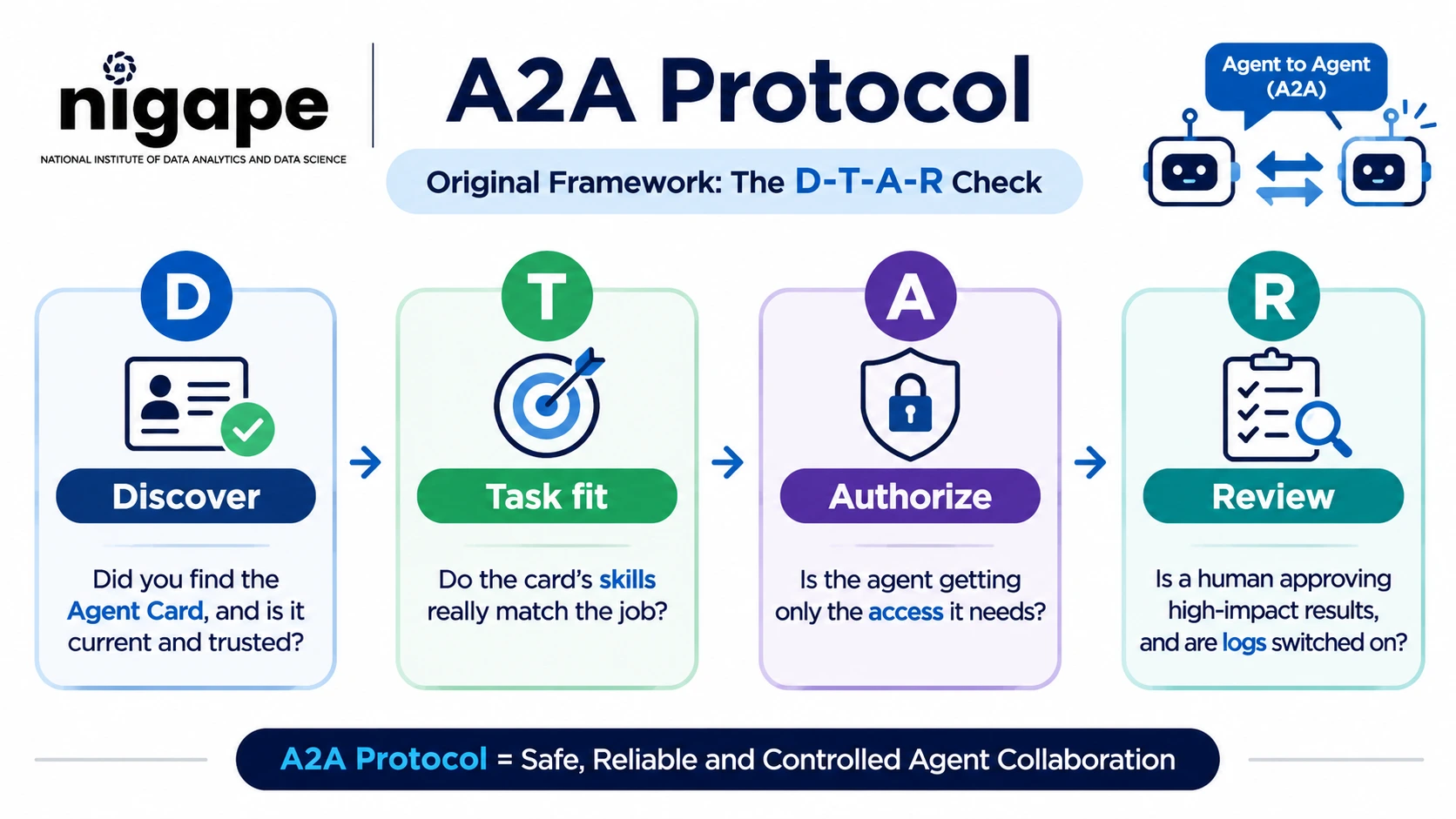
Original Framework: The D-T-A-R Check
Before you connect any two agents in AI agent development, run through this four-step check:
● D — Discover: Did you find the Agent Card, and is it current and trusted?
● T — Task fit: Do the card’s skills really match the job?
● A — Authorize: Is the agent getting only the access it needs?
● R — Review: Is a human approving high-impact results, and are logs switched on?
I came up with this for my classes. It isn’t part of the official spec.
A2A vs MCP vs Traditional APIs
Factor | A2A Protocol | MCP | Traditional API |
Connects | Agent to agent | AI app to tools and data | Software to software |
Style | Messages and tasks | Client-server calls | Fixed requests |
Discovery | Agent Card | Server capabilities | Docs or OpenAPI |
Long jobs | Built-in task states | Not its main focus | Custom design |
Example | A travel agent asks an airline agent to book | An agent reads a database | An app calls a weather API |
None of these replaces the others. A2A runs on ordinary web technology, so APIs still matter. And a remote agent can use MCP behind the scenes to reach its own tools.
Use Cases (Illustrative)
● Customer support: triage, billing and technical agents work on one shared case, and a human reviews refunds.
● Software teams: coding, testing and review agents pass work along, and humans approve merges.
● Finance and healthcare admin: agents prepare the data, while humans approve payments and handle privacy.
Tools, Benefits and Limitations
Tools: the a2a-sdk Python package (Python 3.10+), the official a2a-samples repository, and the A2A Inspector for testing.
Benefits: it works across frameworks, agents become reusable, you write less custom integration code, and it supports long-running and streaming tasks.
Limitations: it brings security and trust risks, and version differences between 0.3 and 1.0 can trip you up. On its own, it won’t make agents more accurate, cheaper or faster.
Best Practices and Common Mistakes
Best practices: use HTTPS and strong authentication, verify agent identity, give least privilege, validate inputs, keep secrets out of messages, log everything, and require human approval for risky actions.
Common mistakes:
● Trusting any agent just because it has an Agent Card.
● Treating messages from other agents as safe instructions.
● Ignoring spec version differences.
● Skipping error handling for failed tasks.
Evidence and Original Insights
The Linux Foundation (9 April 2026) reported more than 150 supporting organizations, integrations on major cloud platforms, and enterprise production use. From my own teaching, I’ve seen beginners learn faster by building two tiny agents than by reading the full spec first.
Frequently Asked Questions
1. What is A2A Protocol in AI?
It’s an open standard that lets AI agents discover each other and share tasks, even across different frameworks.
2. What is the difference between A2A and MCP? .
A2A connects agents to agents. MCP connects agents to tools and data. Plenty of systems use both.
3. What is the full form of A2A?
Agent2Agent, also written Agent-to-Agent.
4. Who created A2A Protocol?
Google introduced it in April 2025, and the Linux Foundation has hosted it since June 2025.
5. How does A2A Protocol work?
A client agent reads an Agent Card, sends a message, and tracks the task until it completes.
6. What is an Agent Card?
It’s a JSON file describing an agent’s skills, interfaces and security needs.
7. Is A2A Protocol open source?
Yes. It’s hosted by the Linux Foundation, and the Python SDK uses the Apache 2.0 license.
8. Does A2A Protocol support Python?
Yes. Install a2a-sdk with Python 3.10 or newer.
Conclusion
A2A gives AI agents one shared way to find each other, hand off work and return results. That matters because real systems rarely rely on a single vendor’s agents. My advice is to start small. Get comfortable with Agent Cards, tasks and messages first. Then install the official Python SDK, run the Hello World sample, and build two simple agents that pass one task between them. Before anything touches a real business workflow, add authentication, logging and human approval. Learn the basics now, because multi-agent systems will need shared standards.