
·



Stories & Updates
Insights that move Generative AI forward
Explore our latest articles, guides, and practical industry insights on Generative AI and Prompt Engineering.

Free Image Generator AI Tools: Complete Guide for Students, (2026)
Free image generator AI tools are software platforms that convert text-based descriptions into images using deep learning models — at no cost to the user. The global AI image generation market was valued at $299.4 million in 2023 and is projected to reach $917.4 million by 2030, growing at a CAGR of 17.4% (Grand View Research, 2024). Adoption is accelerating across education, marketing, and content creation industries.
Continue reading →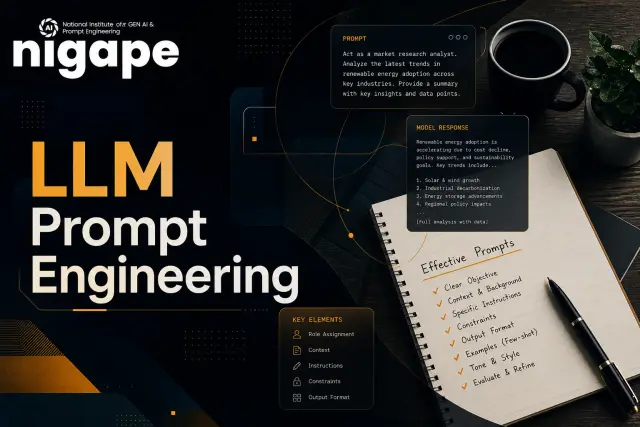
LLM Prompt Engineering: Techniques, Examples, and How to Write
LLM prompt engineering is the process of designing structured inputs (prompts) to get accurate, relevant, and useful outputs from a large language model (LLM). LLMs generate responses based on statistical patterns from training data. The quality, structure, and specificity of the input directly determines the quality of the output. Related terms: AI prompting strategy, structured prompting, effective AI prompts, prompt design
Continue reading →
How to Write AI Prompts That Actually Work ( Guide 2026)
An AI prompt is the instruction you give an AI tool. The quality of that instruction directly determines the quality of the output. Most users get poor results not because the AI tool is limited, but because the prompt lacks the information the model needs to perform the task correctly. This guide covers: what an AI prompt is, how to write AI prompt instructions that produce reliable results, common mistakes to avoid, prompt templates you can use immediately, real before-and-after examples, and how to build an AI content workflow that scales.
Continue reading →
AI Prompt Examples That Skyrocket Your Results 2026
AI prompt example: A structured input instruction — containing role, context, task, and format — given to a language model to produce a specific, usable output. Effective AI prompt: A prompt that is replicable, goal-specific, and produces an output requiring minimal post-generation editing.
Continue reading →
Generative AI Use Cases 2026: Real Applications, Industries & How to Start
Definition: A generative AI use case is a defined task where an AI model generates a useful output — text, code, image, or data — that reduces human time or effort. In 2026, these use cases are no longer experimental. They are active inside company workflows, freelance pipelines, academic institutions, and individual career strategies.
Continue reading →
Prompt Engineering Guide 2026 Techniques, AI Prompting Strategy
Prompt engineering is the practice of designing structured input instructions for AI language models to produce accurate, specific, and repeatable outputs. A prompt engineering guide is a reference framework that documents techniques, formats, and workflows used to improve AI output quality across tasks. At Nigape, we define prompt engineering as a core competency for anyone using generative AI in professional workflows.
Continue reading →
Generative AI Tools 2026: Best Tools, Skills & Career Impact
Generative AI tools 2026 are software systems that create text, images, code, audio, or video from user prompts. They are now standard professional tools across marketing, tech, legal, and education — with AI literacy ranked the #1 in-demand skill globally (WEF, 2026).
Continue reading →
Learn AI and Prompt Engineering Online: Skills, Tools, and Career
Prompt engineering is the practice of writing structured instructions (prompts) to direct AI models toward specific, accurate, and usable outputs. Learning AI and prompt engineering online refers to acquiring this skill through digital courses, guided modules, and project-based practice on platforms such as Coursera, DeepLearning.AI, Udemy, and LinkedIn Learning.
Continue reading →
AI Course for Student After 12th: Skills, Careers, and Data Guide 2026
An AI course for student after 12th is a beginner-level training program that teaches practical use of artificial intelligence tools, prompt engineering techniques, and AI content workflow — with no prior coding or technical background required. Students from Science, Commerce, or Arts streams are eligible. Course duration ranges from 4 to 16 weeks. Fee range in India: ₹0 (free audit) to ₹50,000.
Continue reading →
Generative AI Career Opportunities in India: Jobs, Skills & Salaries
Generative AI career opportunities in India are professional roles where the primary function involves creating, managing, deploying, or improving AI systems that generate text, images, code, audio, or video outputs. According to NASSCOM's 2024 report, India requires over 1 million AI-skilled professionals by 2026. As of 2024, fewer than 416,000 professionals in India hold verified AI or ML skills — leaving a gap of more than 580,000 positions. These generative AI career opportunities exist across sectors including IT services, digital marketing, edtech, healthcare, legal services, media, and e-commerce. The World Economic Forum's Future of Jobs Report 2023 ranks AI and Machine Learning Specialists among the top 5 fastest-growing roles globally. India, as the world's second-largest technology talent pool, is central to this hiring surge.
Continue reading →
Prompt Engineering Course with Placement: , Skills, and Career
prompt enginnering course with placement: Learn in-demand AI skills, build real projects, and secure job-ready expertise with guaranteed career support.
Continue reading →
Best Generative AI & Prompt Engineering Certification Course (2026)
What Is Generative AI? Generative AI refers to artificial intelligence systems that create new content — text, images, audio, video, or code — by learning patterns from large datasets. Unlike traditional software that follows fixed rules, generative AI produces original outputs in response to user inputs called prompts. What Is Prompt Engineering? Prompt engineering is the practice of designing and structuring the inputs — called prompts — that you give to an AI model, in order to get accurate, relevant, and consistent outputs. It involves choosing the right format, setting context, specifying tone, and defining constraints. No coding is required.
Continue reading →
Real Examples of AI Prompts: Structure, Use Cases, and Industry Applications
Definition: What Is a Real Example of AI Prompts? A real example of AI prompts is a structured instruction given to a large language model (LLM) that includes the task, target audience, desired tone, output format, and length. Unlike vague inputs, structured prompts consistently produce accurate, usable outputs without multiple revision cycles. Key components of a structured AI prompt: • Task definition — what the AI must produce • Audience specification — who the output is for • Tone and style — formal, casual, technical • Format — word count, structure, headings, bullets • Constraints — what to avoid or include
Continue reading →
Best Generative AI & Prompt Engineering Course After 12th (2026)
A generative AI and prompt engineering course after 12 is a structured, beginner-level program covering two interconnected disciplines: • Generative AI: The technology that powers tools like ChatGPT, Google Gemini, Claude, and Midjourney — capable of generating text, images, code, and structured content from natural language inputs. • Prompt Engineering: The practice of writing precise, structured instructions that guide AI models to produce specific, accurate, and formatted outputs consistently.
Continue reading →
What Is Generative AI and Prompt Engineering? Skills, Career
People are searching “What is Generative AI and Prompt Engineering?” because these technologies are rapidly being adopted across industries such as marketing, education, software development, and design. The rise of tools like ChatGPT and AI image generators has increased public interest in understanding how these systems work and how they can be used effectively. Generative AI refers to artificial intelligence systems that can create new content, including text, images, audio, and code, based on patterns learned from large datasets. It uses advanced models like transformers and large language models to generate outputs that resemble human-created content.
Continue reading →