
·


October 9, 2026
BSc in Artificial Intelligence: Course, Fees & Careers
BSc in Artificial Intelligence: Complete Course, Fees, Syllabus & Career Guide
I see Artificial Intelligence or AI as a force that is changing how businesses organizations and people use technology. Artificial Intelligence is becoming more and more important in digital systems. It shows up in chatbots, recommendation engines, data analytics and intelligent automation.
I believe a BSc in Artificial Intelligence is a choice, for students who want to dive into Artificial Intelligence, machine learning, programming, data analysis and intelligent computer systems. It is a blend of computer science fundamentals, AI‑specific concepts and hands‑on learning.
If you are planning to pursue an Artificial Intelligence degree after Class 12 it is useful to know the course details, eligibility, syllabus, fees, duration, skills and career options so you can make an academic decision.
Key Takeaways
. BSc in Artificial Intelligence combines computer science, math, coding, data and smart systems.
.Eligibility requirements are different at universities.
.Common classes are programming, logic, artificial intelligence, machine learning, math and data science.
.The usual time to finish is three years.
.Costs vary depending on the school. What it offers.
.Students can build thinking and solving skills.
.Jobs can be, in intelligence, machine learning, data, software, automation and research.
.Projects and real work experiences can help add to what students learn.
.Students should check the classes, costs what's available work opportunities and job help before picking a school.
What Is BSc in Artificial Intelligence?
Artificial Intelligence BSc is an undergraduate degree that looks at intelligent technologies and how computers can solve problems. Students learn how computers handle information, spot patterns, work with data and carry out tasks that usually need thinking.
The program typically includes classes in programming, math, algorithms, databases, artificial intelligence, machine learning and data science. Some universities also offer courses, in learning, natural language processing, computer vision, robotics and cloud computing depending on the course setup.
Each university may have a curriculum so students should review the official course structure carefully before deciding on a school.
BSc Artificial Intelligence Course Overview
A BSc Artificial Intelligence course usually mixes theory and hands‑on practice. Students often start with programming, mathematics and basic computer science before moving to Artificial Intelligence topics.
Common areas of study include:
Programming fundamentals
Data structures and algorithms
Mathematics and statistics
Database management
Computer networks
Artificial intelligence
Machine learning
Data science
Deep learning
Natural language processing
Computer vision
Robotics
Cloud computing
AI projects and practical laboratories
Practical projects help students put classroom ideas into real‑world problems. Some institutions also offer internships, workshops, industry projects or research opportunities.
BSc in AI Eligibility
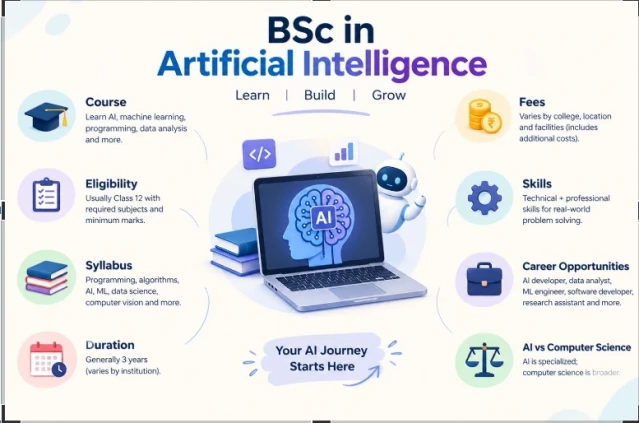
The BSc in AI eligibility criteria vary from one university or college to another. Usually the BSc in AI eligibility criteria require students to finish Class 12 or a similar qualification that comes from a recognised board.
Certain institutions may ask for subjects like Mathematics, Physics, Computer Science or other science‑related subjects. The BSc in AI eligibility criteria also include a percentage and may ask for an entrance examination but these details differ.
Common requirements may include:
- Completion of Class 12 or equivalent education is part of the BSc in AI eligibility criteria.
- Meeting the required minimum percentage is part of the BSc in AI eligibility criteria.
- Having required subjects, such as Mathematics, where applicable's part of the BSc in AI eligibility criteria.
- Meeting entrance examination requirements if applicable is part of the BSc in AI eligibility criteria.
- Fulfilling university‑specific admission conditions is part of the BSc, in AI eligibility criteria.
Students should check the BSc in AI eligibility criteria with the specific institution before they apply.
BSc Artificial Intelligence Syllabus
The BSc Artificial Intelligence syllabus generally combines computer science, mathematics, data, and intelligent systems.
Subject | Main Focus |
Programming | Coding and software development |
Mathematics | Concepts used in computing and AI |
Statistics | Data analysis and statistical reasoning |
Data Structures | Organizing and processing information |
Algorithms | Computational problem-solving |
Databases | Storing and managing data |
Artificial Intelligence | Intelligent system fundamentals |
Machine Learning | Learning patterns from data |
Deep Learning | Neural networks and advanced ML |
NLP | Processing human language |
Computer Vision | Working with images and visual data |
The exact syllabus can be different depending on the university. Some programs place emphasis on machine learning and data science. Others might also cover topics, like robotics or LLM Prompt Engineering.
BSC AI Course Duration
The BSc AI course duration is usually three years when it is a normal undergraduate program.. The BSc AI course duration can change based on the university the academic structure and the way the degree is set up.
Some BSC AI Diploma course programs may have internships, extra practical semesters or industry projects. Students need to look at the academic structure to know the full BSc AI course. The semester schedule.
BSc Artificial Intelligence Fees
BSc Artificial Intelligence fees can be different depending on where you study the college, the facilities available the courses offered and whether the university is public or private. It’s not about tuition. Students also have to think about costs like admission and exam fees, lab charges, books and study materials, software or tech tools needed staying in a hostel or renting a place to live getting around and money for projects.
When choosing a college students should look at more than the fee. They should check how good the curriculum is, the quality of teachers how well-equipped the labs are, chances for internships how much real-world industry experience is offered, whether the program is accredited and if the college helps with job placements, after graduation.
Skills You Can Develop
An AI-focused degree can help students develop technical, analytical, and professional skills.
Technical Skills
Students may learn:
Python and other programming languages
Data analysis
Statistics
Algorithms
Databases
AI frameworks
Data visualization
Cloud technologies
Professional Skills
Students can also develop:
Problem-solving
Critical thinking
Analytical reasoning
Research skills
Communication
Teamwork
Project management
Practical projects and internships can help students apply these skills in real-world situations.
BSc AI Career Opportunities
There are several BSc AI career opportunities across technology and data-driven industries. The exact role depends on a graduate's skills, experience, specialization, and employer requirements.
Career Option | Typical Responsibilities |
AI Developer | Builds applications using AI technologies |
Machine Learning Engineer | Develops and improves ML models |
Data Analyst | Analyzes data and generates insights |
Data Scientist | Works with data, statistics, and predictive models |
AI Research Assistant | Supports AI research and experimentation |
Automation Specialist | Develops technology-based automated workflows |
Software Developer | Designs and develops software applications |
NLP Specialist | Works with language-based AI applications |
AI is used in areas, like healthcare, finance, education, manufacturing, retail, transportation and software. People who finish school can then look into fields depending on what they know and what they are able to do.
BSc AI vs Computer Science
Students often compare an AI-focused degree with a general computer science program.
Feature | BSc Artificial Intelligence | Computer Science |
Main Focus | AI, ML and intelligent systems | Broad computing concepts |
Programming | Core component | Core component |
Machine Learning | Major focus | May be a specialization |
AI | Central subject | One area within computing |
Data | Strong emphasis | Depends on curriculum |
Career Areas | AI, ML, data and automation | Software, IT, systems, data and more |
Curriculum | More specialized | Generally broader |
Students should choose a program based on their interests, preferred curriculum, academic goals, and the opportunities offered by the institution.
How to Prepare for an AI Career
A degree gives an academic foundation yet practical learning can further strengthen a students profile.
I believe that a solid academic foundation from a degree is important but practical learning can further strengthen a students profile.
1. Learn Programming
Build a foundation in Python in programming fundamentals in data structures and in algorithms.
I recommend building a foundation in Python in programming fundamentals in data structures and in algorithms.
2. Strengthen Mathematics
Learn statistics, probability, linear algebra and other math concepts that're relevant to AI.
AI needs a math base so learn statistics, probability, linear algebra and other math concepts that are relevant to AI.
3. Build Projects
Create projects such as chatbots, recommendation systems, prediction models, image classification applications or data dashboards.
4. Learn Machine Learning
Understand how models are trained, tested, evaluated and improved using datasets.
5. Gain Experience
Internships, hackathons, academic projects and open‑source contributions can provide valuable hands‑on experience.
6. Keep Learning
Artificial intelligence is always changing so students need to keep looking at tools, new methods, new ways of working and what is happening in the industry.
FAQs
Q.What is BSc in Artificial Intelligence?
It is an undergraduate degree that focuses on intelligence, machine learning, programming, data analysis and related technologies.
Q.What are the eligibility requirements for BSc AI?
Eligibility depends on the university. Generally students need Class 12 or an equivalent qualification. Must meet the required subjects and marks.
Q.How long is a BSc AI degree?
A standard BSc AI program is commonly three years although the duration can vary by institution.
Q.What subjects are taught in BSc AI?
Common subjects include programming, mathematics, statistics, algorithms, artificial intelligence, machine learning, databases and data science.
Q.What jobs can I get after BSc AI?
Graduates can explore roles such, as AI developer, machine learning engineer, data analyst, software developer, automation specialist and research assistant depending on their skills and employer requirements.
Q.Can I pursue studies after BSc AI?
Yes. Graduates can pursue postgraduate programs in intelligence, machine learning, data science, computer science and related fields.
Conclusion
With the BSc AI degree, students are provided with a foundation in artificial intelligence, programming, machine learning, data, and computer sciences. This can be particularly useful for students wanting to know about technologies and work with them in real-life scenarios.
Before selecting a university it is important to compare the BSc Artificial Intelligence syllabus, eligibility criteria, fees, duration of the course, practical opportunities, quality of faculty and AI Jobs in India. And each of these things are a big deal in determining which program is the right one.
Students should try to combine learning with hands-on programming practice. Internships and keeping abreast of developments in the field can help you acquire the skills you need to succeed. AI changes fast, so keeping up with learning is a must.
About the Author
Quick facts
Name: Shagun
From: Delhi
Education: B TECH
Program: Generative AI and Prompt Engineering
Placed in: NIGAPE (National Institute of generative ai and prompt engineering)
Covers topics: Generative AI, Prompt Engineering, Large Language Models (LLMs), AI Tools & Automation, Machine Learning, Conversational AI
Currently working as: Senior Generative AI & Prompt Engineering Trainer
In her words: "Prompt engineering and gen AI isn't about finding magic words — it's about understanding how the model thinks. That's the skill I help people build every single day."