June 3, 2026
Top ML Algorithms Explained — 2026 Guide
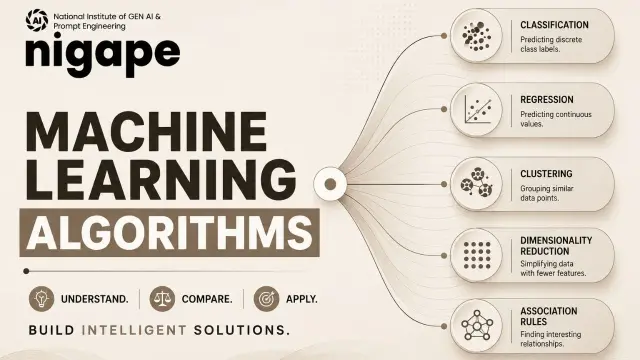
Machine Learning Algorithms: 2026 Complete Guide
Machine learning algorithms are mathematical methods that allow computers to learn from data, identify patterns, and make decisions without being explicitly programmed. They power AI applications across healthcare, finance, cybersecurity, and e-commerce — from cancer detection to fraud prevention.
Machine Learning: Market & Adoption Statistics (2026)
These figures reflect the current scale and trajectory of the global ML industry:
• Global ML market size reached $113.9 billion in 2025 (Grand View Research, 2025).
• The ML market is projected to grow at 36.2% CAGR through 2030 (MarketsandMarkets).
• 77% of enterprise organizations have AI or ML deployed in production (McKinsey Global AI Survey, 2024).
• ML-related job postings grew 74% over the past four years (LinkedIn Workforce Report, 2024).
• Organizations using ML report an average 25% reduction in operational costs (IBM Institute for Business Value, 2024).
• Healthcare AI — largely ML-driven — is projected to reach $188 billion by 2030 (Statista, 2025).
Key Takeaways
• Machine learning algorithms learn patterns from data — no manual rule-writing required.
• Four core types: supervised, unsupervised, semi-supervised, and reinforcement learning.
• Top algorithms: random forest, gradient boosting, SVM, K-Means, and neural networks.
• Real-world use spans healthcare, banking, e-commerce, manufacturing, and cybersecurity.
• Algorithm selection depends on data type, size, and interpretability requirements.
Types of Machine Learning Algorithms
Machine learning algorithms are categorized by how they receive feedback during training.
1. Supervised Learning
Trains on labeled data — each input is paired with a correct output. The model learns the input-output mapping and generalizes to new data.
Algorithms: Linear Regression, Logistic Regression, Decision Trees, Random Forest, SVM, Neural Networks.
Use Cases: Email spam detection, credit scoring, medical diagnosis, price prediction.
2. Unsupervised Learning
Trains on unlabeled data. The algorithm finds hidden structure without guidance.
Algorithms: K-Means Clustering, DBSCAN, PCA, Autoencoders.
Use Cases: Customer segmentation, anomaly detection, topic modeling.
3. Semi-Supervised Learning
Combines small labeled datasets with large unlabeled pools. Reduces annotation cost while maintaining accuracy.
Use Cases: Medical image classification, web content categorization, speech recognition.
4. Reinforcement Learning
An agent learns by interacting with an environment — receiving rewards for correct actions, penalties for incorrect ones.
Use Cases: Autonomous vehicles, robotics, game AI (AlphaGo, Chess engines), algorithmic trading.
For a deeper comparison of learning types, see our guide on Machine learning and artificial intelligence
Top Machine Learning Algorithms: Comparison Table
The table below covers the 8 most widely deployed algorithms across industry:
Algorithm | Type | Best For | Advantage | Limitation |
Linear Regression | Supervised | Price prediction | Simple, interpretable | Assumes linearity |
Logistic Regression | Supervised | Spam, diagnosis | Probabilistic output | Linear boundary only |
Decision Tree | Supervised | Classification | Visual, interpretable | Prone to overfitting |
Random Forest | Supervised | Finance, healthcare | Robust, accurate | Slower to train |
SVM | Supervised | Text, image data | High-dim effective | Slow on big datasets |
K-Means | Unsupervised | Segmentation | Scalable | Needs K predefined |
Gradient Boosting | Supervised | Tabular data | State-of-the-art acc. | Overfit risk |
Neural Networks | Deep Learning | Images, NLP, speech | Universal learner | Data & compute heavy |
Top Machine Learning Algorithms Explained
Linear & Logistic Regression
Linear regression predicts continuous values (e.g., house prices) using the equation y = mx + b. Logistic regression predicts binary outcomes (yes/no) using a sigmoid function — widely used in medical diagnosis and credit scoring.
Decision Trees & Random Forest
Decision trees split data on feature thresholds, forming interpretable if-then-else branches. Random forest builds hundreds of decision trees and aggregates their outputs — reducing overfitting and achieving significantly higher accuracy. Random forest is used in healthcare risk stratification and financial modeling.
Support Vector Machine (SVM)
SVM identifies the optimal hyperplane separating classes with maximum margin. The kernel trick projects data into higher dimensions to handle non-linear problems. Effective for text classification and bioinformatics.
K-Means Clustering
K-Means partitions data into K clusters by minimizing intra-cluster distances. Requires the number of clusters (K) as a parameter. Standard algorithm for customer segmentation, document grouping, and image compression.
Gradient Boosting (XGBoost, LightGBM, CatBoost)
Gradient boosting builds trees sequentially — each tree corrects the residual errors of its predecessor. XGBoost has won more Kaggle competitions than any other algorithm. LightGBM processes structured tabular datasets at scale with sub-linear training time.
Neural Networks & Deep Learning
Neural networks are layered systems of artificial neurons that learn hierarchical representations of data. Deep learning architectures — CNNs, RNNs, Transformers — achieve state-of-the-art results on image recognition, NLP, and speech synthesis. GPT-4, Gemini, and Claude are built on Transformer-based neural networks trained on trillions of tokens.
For a beginner-friendly introduction, read our artificial intelligence prompt
Real-World Machine Learning Applications
• Healthcare: Google DeepMind's AlphaFold predicted the 3D structure of 200 million proteins — a breakthrough in drug discovery. ML models match or exceed radiologist accuracy on specific imaging diagnostics (Stanford HAI, 2023).
• Finance & Banking: JPMorgan's COIN system uses ML to process 360,000 hours of legal document review annually. Fraud detection models at Visa analyze 500+ data points per transaction in milliseconds.
• E-Commerce: Amazon attributes 35% of revenue to its ML-powered recommendation engine (McKinsey, 2023). Netflix's recommendation system saves an estimated $1 billion per year in retention.
• Cybersecurity: ML-based intrusion detection systems reduce false positive rates by up to 60% compared to rule-based systems (IBM Security, 2024).
• Manufacturing: Predictive maintenance using ML reduces unplanned downtime by 50% and maintenance costs by 25% (Deloitte, 2024).
• Transportation: Waymo's autonomous driving system uses a combination of CNNs, LiDAR processing, and reinforcement learning across 20 million real-world miles.
How to Choose the Right ML Algorithm
• Classification task: Start with logistic regression, decision tree, or random forest.
• Regression task: Use linear regression; upgrade to gradient boosting for non-linear data.
• Clustering (unlabeled): K-Means for defined clusters; DBSCAN for irregular shapes.
• Image or text data: Use CNNs for images; transformers or Naive Bayes for text.
• Interpretability required: Logistic regression or decision trees — avoid black-box models.
• Large structured dataset: Gradient boosting (XGBoost/LightGBM) is the benchmark.
Challenges and Limitations
• Data Quality: Biased or incomplete training data produces unreliable models — garbage in, garbage out.
• Explainability: Deep neural networks are not interpretable by default. Explainable AI (XAI) tools like SHAP and LIME partially address this.
• Compute Cost: Training GPT-4 cost an estimated $100 million in GPU compute (OpenAI, 2023). Edge ML is emerging to reduce this.
• Overfitting: A model that memorizes training data fails to generalize. Regularization, dropout, and cross-validation mitigate this.
• Privacy Risks: ML systems trained on personal data must comply with GDPR, HIPAA, and emerging AI regulations.
References & External Sources
The following peer-reviewed and institutional sources informed this article:
1. Stanford University AI Lab — Research on Machine Learning & Deep Learning
2. Google Research — Publications on Neural Networks and Applied ML
Conclusion
Machine learning algorithms are the operational core of modern AI. The global ML market exceeded $113 billion in 2025 and continues expanding at 36% annually. From gradient boosting on tabular data to transformer-based neural networks processing language at scale, these algorithms solve problems that traditional programming cannot.
Algorithm selection is a function of problem type, data characteristics, and interpretability requirements. Supervised learning covers the majority of production use cases. Unsupervised methods handle discovery tasks. Reinforcement learning powers autonomous decision-making systems.
Mastery of machine learning algorithms is among the most in-demand technical skills globally, with 74% growth in ML job postings over four years and sustained enterprise adoption across every major industry.
Frequently Asked Questions
Q1. What are machine learning algorithms?
Machine learning algorithms are mathematical methods that allow computers to learn from data, identify patterns, and produce predictions or decisions without explicit rule programming. Core examples include linear regression, random forest, SVM, K-Means, and neural networks.
Q2. What are the 4 types of machine learning?
Supervised learning (labeled data), unsupervised learning (unlabeled data), semi-supervised learning (mixed data), and reinforcement learning (reward-based sequential decisions).
Q3. Which algorithm is best for beginners?
Linear regression and logistic regression are the standard starting points — mathematically transparent and widely documented. Decision trees add interpretability through visual branching logic.
Q4. What is the difference between ML and deep learning?
Machine learning is the broader field. Deep learning is a subset using multi-layered neural networks. Deep learning requires more data and compute but achieves superior results on images, text, and audio.
Q5. Which algorithm has the highest accuracy on structured data?
Gradient boosting frameworks — specifically XGBoost and LightGBM — consistently achieve the highest accuracy on tabular/structured datasets. They have dominated data science competition leaderboards since 2016.
Nigape | National Institute of Generative AI & Prompt Engineering (NIGAPE)
Build Your AI Career in GenAI & Prompt Engineering. Learn through immersive campus and online cohorts. Build real projects in Generative AI, Prompt Engineering, agents, and automation with mentor support for internships and placements.