June 4, 2026
Deep Learning AI: What It Is & How It Works
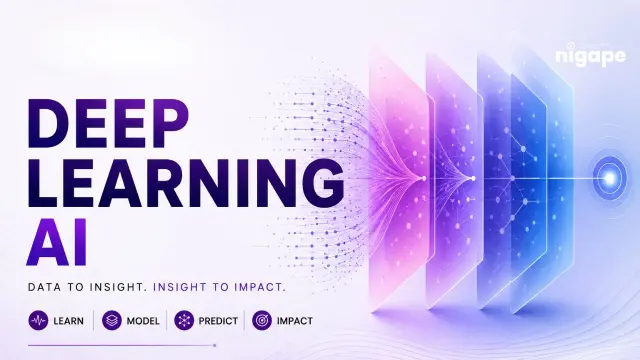
Deep Learning AI: What It Is, How It Works & Real-World Applications (2026)
Deep learning AI is a subset of artificial intelligence that uses multi-layered neural networks to learn directly from large datasets. It powers image recognition, voice assistants, fraud detection, autonomous vehicles, and large language models — including ChatGPT, Claude, and Gemini. This article covers the architecture, key model types, industry statistics, and verified real-world applications.
Deep Learning Industry Statistics (2025–2026)
The following figures are drawn from major market research reports and analyst forecasts published in 2025:
$2.6T Global AI Spending 2026 Gartner Forecast | 44.9% Deep Learning Market CAGR Through 2031 (MarketsandMarkets) | 77% Enterprise AI Adoption Rate McKinsey Global Survey 2025 | $91.7B GPU Market Size 2025 Grand View Research |
Sources: Gartner Worldwide AI Spending Forecast 2026; McKinsey Global AI Survey 2025; Grand View Research GPU Market Report 2025; MarketsandMarkets Deep Learning Market Forecast 2031.
Deep Learning At a Glance ▸ Definition: A subset of machine learning using multi-layered neural networks to automatically learn patterns from large datasets — no manual feature engineering required. ▸ Key Benefits: Automatic feature extraction · State-of-the-art accuracy on unstructured data · Scalability · Transfer learning ▸ Core Limitations: High data & compute requirements · Black-box interpretability · Bias amplification · Adversarial vulnerability ▸ Popular Models: ANN · CNN · RNN/LSTM · Transformer · GAN · Diffusion Models ▸ Top Applications: Medical imaging · NLP · Autonomous vehicles · Fraud detection · Generative AI · Drug discovery |
Key Takeaways
• Deep learning is a branch of machine learning that uses layered neural networks — the term 'deep' refers to the number of hidden layers, not task complexity.
• Unlike traditional machine learning, deep learning automatically extracts features from raw data with no manual programming.
• The four primary model types are ANN, CNN, RNN/LSTM, and Transformer.
• Training requires large labeled datasets and GPU/TPU compute clusters.
• Transformers — the architecture behind ChatGPT, Gemini, and Claude — are the dominant model type for language and multimodal tasks in 2026.
• Key limitations: data dependency, high compute cost, and limited model interpretability (black box).
What Is Deep Learning AI?
Deep learning AI is a machine learning method that trains neural networks with multiple hidden layers to recognize patterns in data. Each hidden layer learns increasingly abstract representations: early layers detect basic features (edges, sounds), deeper layers detect complex structures (objects, semantic meaning, intent).
Deep learning is responsible for the majority of AI breakthroughs since 2012: ImageNet-winning CNNs, AlphaFold protein prediction, GPT-series language models, and real-time translation systems. It is not a single algorithm — it is a family of architectures adapted to different data types.
How Deep Learning Works
Data passes through a neural network in a forward pass. Each neuron applies a weighted sum of inputs and an activation function (ReLU, Sigmoid, Softmax). The final layer produces a prediction, which is compared to the correct label via a loss function. The error is propagated backward through the network (backpropagation), and an optimizer (Adam, SGD) adjusts all weights incrementally. This cycle repeats over millions of training examples.
Neural Network Architecture — Layer-by-Layer
INPUT LAYER | ↓ Raw data: image pixels · text tokens · audio waveforms |
HIDDEN LAYER 1 | ↓ Detects basic features: edges, phonemes, character patterns |
HIDDEN LAYER 2 | ↓ Combines features: shapes, words, phrases |
HIDDEN LAYER N | ↓ Learns abstract concepts: objects, semantics, intent |
OUTPUT LAYER | ↓ Final prediction: class label · generated token · decision |
Note: 'N' indicates any number of hidden layers. Modern LLMs use up to 96+ transformer layers; ResNet-152 uses 152 convolutional layers.
What Are Neural Networks?
A neural network is a computational graph of interconnected nodes (neurons) arranged in layers. Key components:
• Neurons (Nodes): Process inputs via a weighted sum + activation function, then pass output to the next layer.
• Weights: Learnable parameters that determine each connection's strength. GPT-4 contains an estimated 1.8 trillion parameters.
• Biases: Constants added to shift the activation threshold, preventing all neurons from activating the same way.
• Activation Functions: Non-linear functions (ReLU, GELU, Sigmoid, Tanh) that allow the network to learn complex, non-linear relationships.
• Loss Function: Quantifies the error between prediction and true label. Common: Cross-Entropy (classification), MSE (regression).
• Optimizer: Algorithm that updates weights to reduce loss. Adam and SGD are the most widely used.
Deep Learning vs. Traditional Machine Learning: Full Comparison
This table covers every critical difference between traditional machine learning and deep learning — the two most compared paradigms in applied AI:
Factor | Traditional Machine Learning | Deep Learning |
Feature Extraction | Manual — engineers define features | Automatic — learned from raw data |
Dataset Size Needed | Works with smaller datasets | Requires large volumes of data |
Training Speed | Faster training | Slower — needs GPUs/TPUs |
Compute Requirement | Standard CPUs sufficient | GPU/TPU clusters required |
Accuracy (unstructured) | Good on structured/tabular data | State-of-the-art on images, text, audio |
Interpretability | More interpretable (white box) | Often a black box |
Human Intervention | High — feature selection required | Low — learns features automatically |
Algorithms | SVM, Random Forest, Gradient Boosting | CNN, RNN, Transformer, Diffusion Models |
Best Use Cases | Tabular data, forecasting, small datasets | Images, audio, text, video, LLMs |
Example Products | Spam filters, recommendation engines | ChatGPT, DALL-E, Tesla Autopilot |
Traditional ML (Random Forest, SVM, XGBoost) still outperforms deep learning on structured/tabular data with limited samples. Deep learning is dominant for unstructured data — images, audio, raw text, video — at scale.
Types of Deep Learning Models
1. Artificial Neural Networks (ANN)
The foundational deep learning architecture. ANNs use fully connected layers and are suited for classification and regression on structured data. They are the simplest form of deep network.
2. Convolutional Neural Networks (CNN)
Designed for grid-structured data (images, video). Convolutional layers apply learned filters to detect spatial features — edges at layer 1, textures at layer 2, objects at deeper layers. CNNs power facial recognition, medical imaging diagnostics, and Tesla Autopilot's perception system.
3. Recurrent Neural Networks (RNN) and LSTM
Built for sequential data where order matters: time series, speech, and text. LSTM (Long Short-Term Memory) and GRU (Gated Recurrent Unit) variants solve the vanishing gradient problem of standard RNNs. Largely superseded by Transformers for NLP but still used in sensor/signal processing.
4. Transformers
The dominant architecture in AI since 2017. Self-attention mechanisms allow the model to weigh relationships between all tokens simultaneously — not sequentially. Transformers underpin every major LLM: GPT-4, Claude, Gemini, LLaMA, Mistral, and BERT. They are also used in computer vision (Vision Transformer / ViT) and multimodal AI.
To understand how Transformers are applied in production systems, see our guide: Generative AI and Large Language Models Explained.
5. Diffusion Models and GANs
Generative architectures used to create images, audio, and video. Diffusion models (Stable Diffusion, DALL-E 3, Midjourney) learn to reverse a noise-addition process to produce high-quality outputs. GANs (Generative Adversarial Networks) train two competing networks: a generator and a discriminator.
Real-World Applications of Deep Learning
The following applications are in active production deployment, not research-stage:
Healthcare
• Medical image analysis: CNNs detect tumors, lesions, and retinal disease in CT/MRI/X-ray scans with radiologist-level accuracy (Aidoc, Zebra Medical).
• AlphaFold (DeepMind): predicted 3D structures of over 200 million proteins — the entire known protein universe — accelerating drug discovery timelines by years.
• Early detection: diabetic retinopathy screening with 90%+ sensitivity in clinical trials (Google Health, 2024).
Finance
• Real-time fraud detection: deep learning models at Visa and Mastercard analyze billions of transactions daily with sub-100ms latency.
• Credit risk scoring and loan default prediction using tabular + behavioral data.
• Algorithmic trading: LSTM and Transformer models used for high-frequency signal generation.
Autonomous Vehicles
• Tesla Autopilot processes 8 camera feeds through CNN-based perception pipelines to detect objects, lanes, and pedestrians in real time.
• Waymo uses deep learning for 3D object detection from lidar + camera sensor fusion.
Natural Language Processing
• Google Translate: Transformer models covering 100+ languages.
• ChatGPT, Claude, Gemini: LLMs used for writing, coding, analysis, and reasoning at scale.
• Enterprise NLP: document classification, contract analysis, customer service automation.
For a technical breakdown of how deep learning is applied in computer vision systems, see: AI in Computer Vision: CNN Architecture Guide.
Limitations of Deep Learning
• Data Dependency: Deep learning models require millions to billions of labeled training samples. ImageNet (14M images), Common Crawl (petabytes of text), and similar datasets are prerequisites for state-of-the-art performance.
• Compute Cost: GPT-4 training cost is estimated at $50M–$100M in compute. Inference at scale requires thousands of A100/H100 GPUs.
• Black Box Problem: It is often impossible to explain why a specific prediction was made — a critical issue in regulated industries (healthcare, finance, legal).
• Adversarial Vulnerability: Imperceptible pixel-level perturbations can cause CNNs to misclassify images with 99%+ confidence — a documented security risk.
• Bias Amplification: Models reproduce and scale biases present in training data. Facial recognition systems have shown documented error rate disparities across demographic groups (MIT Media Lab, 2018; NIST FRVT, 2019).
• Domain Shift: Models trained on one data distribution fail in environments with different characteristics — a known issue in medical AI deployment across hospital systems.
Future of Deep Learning AI (2026 and Beyond)
• Multimodal AI: GPT-4o, Gemini Ultra, and Claude 3 Opus process text, images, and audio in a single model. Multimodal architectures are now the standard for frontier AI systems.
• AI Agents: Deep learning models are used as the core reasoning engine in autonomous agents that plan, use tools, write code, and complete multi-step tasks.
• Efficient Models: Mixture-of-Experts (MoE), quantization, and pruning techniques are reducing model size and inference cost — enabling deployment on edge devices and mobile hardware.
• Regulation: The EU AI Act (effective August 2024) classifies high-risk AI systems and mandates transparency, risk assessment, and human oversight for deep learning applications in healthcare, employment, and law enforcement.
To apply deep learning concepts in real AI projects, explore NIGAPE's curriculum: Prompt Engineering & GenAI Career Program.
Frequently Asked Questions
Q: What is deep learning AI?
Deep learning AI is a machine learning method that uses neural networks with multiple hidden layers to automatically learn patterns from large datasets. It is the technology behind image recognition, speech recognition, language translation, and generative AI — including ChatGPT, Claude, Gemini, and DALL-E.
Q: How is deep learning different from machine learning?
Machine learning is the broader field where algorithms learn from data using statistical methods, typically requiring manual feature engineering by data scientists. Deep learning is a subset of machine learning that uses multi-layer neural networks to automatically extract features from raw data. Deep learning requires more data and compute but achieves higher accuracy on complex, unstructured inputs.
Q: What are CNNs and RNNs?
CNNs (Convolutional Neural Networks) are architectures designed for grid-structured data like images and video — they apply learned spatial filters to detect features at multiple scales. RNNs (Recurrent Neural Networks) are designed for sequential data like text and time series, processing inputs step-by-step with a memory mechanism. LSTM and GRU are improved RNN variants that handle long-range dependencies more effectively.
Q: Is deep learning used in ChatGPT?
Yes. ChatGPT is built on GPT-4, a Transformer-based large language model — a specific type of deep learning architecture. The Transformer uses self-attention to process entire token sequences simultaneously. GPT-4 was pre-trained on hundreds of billions of tokens using deep learning, then fine-tuned using Reinforcement Learning from Human Feedback (RLHF).
Q: What are the main limitations of deep learning?
The five key limitations are: (1) high data requirements — models need massive labeled datasets; (2) large computational cost — training frontier models costs tens of millions of dollars in GPU compute; (3) black-box interpretability — predictions are difficult to explain; (4) adversarial vulnerability — small input perturbations cause catastrophic errors; and (5) bias amplification — models reproduce and scale biases present in training data. These are active areas of AI safety and machine learning research.
Q: What programming language is used for deep learning?
Python is the dominant programming language for deep learning, used in approximately 80–90% of production and research implementations. Its ecosystem includes the leading frameworks: PyTorch (favored in research and increasingly in production), TensorFlow/Keras (widely deployed at scale by Google and enterprise teams), JAX (used internally at Google DeepMind for frontier model research), and Hugging Face Transformers (the standard library for pre-trained model access). Python’s dominance is driven by its concise syntax, extensive scientific libraries (NumPy, Pandas, scikit-learn), and CUDA integration for GPU acceleration. R and Julia have niche deep learning support, but Python is the industry standard. For career entry into deep learning, Python proficiency is a non-negotiable baseline.
Q: How long does it take to train a deep learning model?
Training time varies by several orders of magnitude depending on model size, dataset volume, and available hardware. A small CNN trained on a standard image dataset (e.g., CIFAR-10) can converge in minutes to a few hours on a single GPU. A mid-size Transformer fine-tuned on a domain-specific corpus typically takes hours to days on a multi-GPU server. Frontier large language models are in a different category entirely: GPT-3 required approximately 355 GPU-years of compute; GPT-4 and comparable models are estimated at thousands of GPU-years spread across clusters of thousands of A100/H100 chips running for weeks to months. For practitioners, transfer learning dramatically reduces training time — fine-tuning a pre-trained model (e.g., a BERT or LLaMA checkpoint from Hugging Face) on a custom task typically requires hours on a single GPU, not weeks. Cloud platforms (Google Colab, AWS SageMaker, Azure ML) make GPU access accessible for training at small to medium scale.
Conclusion
Deep learning is the core technology behind the most significant AI capabilities deployed at scale today. Its ability to automatically extract hierarchical features from raw data — without manual engineering — has produced measurable, documented advances in medical imaging, natural language processing, autonomous systems, and generative AI.
With global AI spending projected at $2.6 trillion in 2026 and the deep learning market growing at 44.9% CAGR through 2031, this is not an emerging technology — it is a present-day production reality. Understanding its architectures, applications, and limitations is a baseline competency for anyone working in AI, data science, or technology.
By Nigape | National Institute of Generative AI & Prompt Engineering (NIGAPE)
Build Your AI Career in GenAI & Prompt Engineering. Learn through immersive campus and online cohorts. Build real projects in Generative AI, Prompt Engineering, agents, and automation with mentor support for internships and placements.